
Top SEO Effectiveness Statistics in 2026

If you run a small business, here is the honest version. SEO effectiveness is not about rankings, impressions, or how many keywords you track in a tool.
It is about revenue from organic search. Everything else is just the trail that leads you there.
In this guide, we are pulling together the most useful SEO statistics for 2026 and showing you how they actually translate into decisions. The kind that grows organic traffic, leads, and sales. Not just nice-looking dashboards.
At Dandy Marketing, we keep things simple. We tie SEO efforts to real outcomes, fix what is holding performance back, and double down on what is already working in search engine results pages.
SEO Effectiveness Statistics That Actually Matter
There are a lot of SEO stats floating around. Most are interesting. Fewer are useful.
These are the ones that actually shape how search engines and people behave:
- 53% of all website traffic comes from organic search
- The #1 result in Google’s organic search results has an average CTR of 27.6%
- SEO can deliver ROI as high as 22:1, with some industries going far beyond that
- 46% of Google searches have local intent
- Around 40% of voice search results come from featured snippets
- The average voice search result is about 29 words
What matters is not memorising these numbers. It is understanding what they mean in practice.
For example, if nearly half of google searches are local, then ignoring local SEO is not a small mistake. It is a big one.
SEO Packages
How We Measure SEO Effectiveness (Without Making It Painful)
You do not need ten tools and a complicated setup to measure SEO performance properly.
You just need a clear line between search visibility and results.
Here is what we actually use day to day:
- Google Search Console for search queries, impressions, and search rankings
- GA4 for conversions, revenue, and what people actually do on your site
- A rank tracking tool to understand search engine visibility and market share
That is it. The magic is not in the tools. It is in how you use them.
Step 1: Start with revenue, not rankings
It is tempting to start with keywords. Most people do.
We start with revenue and leads, then map backwards:
- Organic search traffic
- Conversion rate
- Search engine rankings
- Visibility across search engines
Also, a quick reality check. A small number of web pages usually drive most of your results. Find them. Improve them. Then expand.
Step 2: Build a dashboard you will actually look at
If your dashboard feels like hard work, you will not use it.
Keep it simple:
- Impressions, clicks, CTR, average position
- Top landing pages from organic search
- Filters for mobile search, desktop, brand, non-brand
This gives you a weekly snapshot without overthinking every fluctuation.
Step 3: Focus on what moves the needle
Not all SEO tasks are equal.
The ones that usually matter most:
- Title tags and meta descriptions that actually match intent
- Internal links that guide both users and search engines
- Content that answers real questions
- Visibility in featured snippets and Google’s AI overviews and AI engines
Core SEO KPIs and Benchmarks for 2026
Here is the thing. Rankings feel important, but they are only useful if they lead somewhere.
What actually matters:
- Organic search drives over half of all web traffic
- Organic results often outperform paid search when it comes to trust and engagement
- SEO can deliver lower cost per lead than many paid channels
- 91% of marketers say SEO helps them hit their goals
How it all connects (in real life)
Think of SEO like a chain reaction:
- Your pages show up more often for relevant search queries
- More people click because your titles and meta descriptions make sense
- Traffic increases
- Visitors find what they expected and convert
- Revenue grows
A quick example to bring this to life:
- A product page goes from 50,000 to 70,000 impressions.
- CTR improves from 2.5% to 3.4%.
- Clicks jump from 1,250 to 2,380.
With a steady conversion rate, revenue almost doubles.
Nothing fancy. Just better alignment with what people are already searching for.
SEO Metrics Table: What to Track (And Why You Should Care)
| Metric | What it shows | Why it matters |
| Impressions | How often you appear in search engine results pages | Tells you if search visibility is growing |
| Average click through rate | How often people click your result | Shows how compelling your listing is |
| Search rankings | Where you appear in search results | Impacts how much search traffic you can get |
| Organic traffic | Visits from organic search | Measures reach and demand |
| Conversion rate | Percentage of visitors who take action | Connects organic traffic to revenue |
| Search terms | What people actually search | Reveals intent and keyword opportunities |
| Search engine visibility | Your share of search engine results | Shows your position against competitors |
| Page speed | How fast your pages load | Affects rankings and overall user experience |
| Leads / Revenue | Are you generating sales or new business | Traffic is a vanity metric, you need to use SEO to drive new business. |
| Mobile performance | How your site works on mobile devices | Critical for mobile users and mobile search |
| Backlinks | Authority signals from other websites | Helps build trust and improve search engine rankings |
Rankings, CTR, and How People Actually Click
Here is where things get interesting.
Search rankings are not a straight line. Moving up a few positions can have very different results depending on where you start.
Jumping from position 8 to 3 can transform your traffic. Moving from 3 to 2 might barely move the needle unless your snippet stands out.
Why?
- Most clicks happen on the first page
- Google searchers click what feels most relevant, not just what is highest
- SERP features like featured snippets, videos, and AI overviews change what people see first
Also, position is not everything. If your result is pushed down by ads or maps, fewer people will see it, even if your ranking looks strong in a tool.
Featured Snippets, AI Overviews, and Voice Search
This is where modern SEO starts to feel a bit different from a few years ago.
Featured snippets and voice search answers are now a big part of how people get information.
Some key points:
- Around 40% of voice search results come from featured snippets
- Most voice search results rank in the top three
- The average voice search answer is short and to the point
How to give yourself a shot
- Use headings that sound like real questions
- Answer them clearly and quickly
- Keep answers concise
- Add FAQ sections where it makes sense
Google’s AI overviews are also changing behaviour. They can reduce clicks for broad queries, but they still reward content that is clear, useful, and easy to understand.
Technical SEO and Site Performance
Technical SEO is not the most exciting part of SEO, but it is often the difference between growth and frustration.
A few useful stats:
- Improving load time can increase conversions by over 8%
- Very few websites perform equally well on mobile and desktop
- Mobile search continues to dominate, especially among smartphone users
What actually matters
- Site speed and page speed
- Mobile usability
- Clean indexing and crawlability
- Overall website’s technical health
Quick wins you can act on
- Compress and optimise images
- Reduce unnecessary scripts
- Fix broken internal links
- Keep page layouts simple and fast
Sometimes the biggest gains come from making things work properly, not adding more content.
Content, Keywords, and Building Authority
Content marketing is where SEO compounds over time.
But there is a catch. More content does not automatically mean better results.
A couple of realities:
- Most keywords have very low search volume
- A noticeable percentage of google searches are completely new
What this means for your SEO strategy
You need balance:
- Breadth so you cover a wide range of relevant keywords
- Depth so you build authority in your core areas
What works best
- Solid keyword research grounded in real search intent
- Content that answers actual questions
- Internal links that connect related pages
- A natural tone that sounds like a human wrote it
Thin or generic AI generated content will not cut it anymore. People can feel the difference, and so can search engines.
Link Building That Still Works
Link building is still a key part of SEO success, but the rules have changed slightly.
It is less about volume and more about relevance and trust.
Key SEO stats:
- Top-ranking pages tend to have significantly more backlinks
- Most SEO professionals still see links as a major ranking factor
What to focus on now
- Links from relevant, trustworthy sites
- Natural growth over time
- Context that makes sense to readers
Digital PR, original data, and genuinely useful content tend to earn better links than mass outreach.
Local SEO and Real-World Results
If you serve a local area, this is where things get very practical very quickly.
Local SEO statistics tell a clear story:
- 46% of searches have local intent
- 76% of people visit a business within 24 hours
- 28% of local searches result in a purchase
What helps you stand out
- A well-optimised Google Maps and Google Business Profile
- Consistent business details everywhere
- Reviews and user generated content
- Regular updates and fresh photos
Local search is often high intent. People are not browsing. They are deciding.
A Simple SEO Process That Actually Works
If everything above feels like a lot, here is the simplified version:
- Define your goals and what counts as a conversion
- Build content around real topics your audience cares about
- Set up Google Search Console and GA4 properly
- Publish, measure, and improve based on what happens
That is it. No overcomplication needed.
A Dandy Case Study
Huddle is a leading branding and creative agency in a crowded market where strong design alone isn’t enough to drive consistent inbound work. They needed their search visibility to match the quality of their brand and turn more of their online interest into real leads.
The Starting Point
Before we stepped in, Huddle had:
- Limited content and minimal optimisation
- No clear SEO strategy guiding topics or search queries
- A site that wasn’t set up to attract and convert organic search traffic effectively
Their creative was strong, but their SEO effectiveness lagged behind. They needed a focused search engine optimization strategy that would help them stand out on search engine results pages and drive measurable growth.
What We Did
We began working with Huddle in March 2021 and treated the project as a full SEO effectiveness programme, not just a rankings boost.
Audit and technical fixes
- Cleaned and optimised internal links
- Improved navigation and page speed
- Refined title tags and meta description
These changes strengthened usability, site speed, and search engine rankings, making every visit from organic search more valuable.
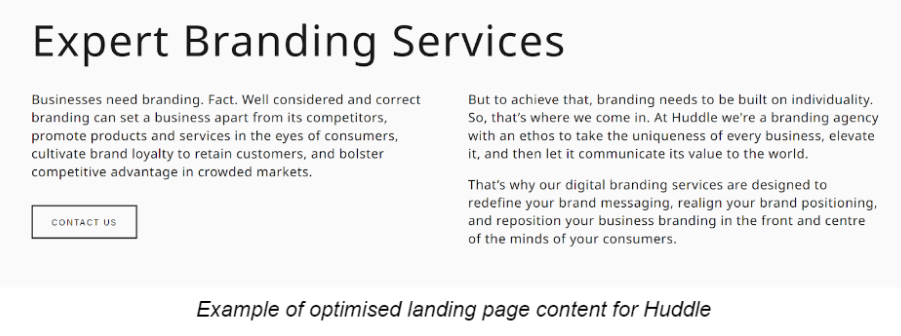
Content and on-page optimisation
- Optimised existing landing pages and built new service pages
- Added social proof and clear CTAs on key pages
- Created a steady flow of 2–3 authoritative blog and long-form pieces per month
This intent-led content helped Huddle capture more relevant keywords, boost organic traffic, and turn more visitors into enquiries.
Link building and authority
- Secured at least five quality backlinks each month
- Used guest posts, interviews, podcasts, and relationship-based outreach
These authority signals supported rankings and helped Huddle compete in a saturated creative market.
The Results
The impact on SEO effectiveness was clear and measurable:
- 619% increase in traffic
- 1000% increase in leads
- 203 first-page rankings secured
Huddle didn’t just get “more SEO.” They saw a direct improvement in organic traffic, search visibility, and the number of qualified leads coming through their site.
Takeaway Box: What Huddle Shows About SEO Effectiveness
- Start with a full audit so you know exactly what’s holding back performance.
- Fix technical SEO first to make every visit from organic search work harder.
- Build intent-led content around relevant keywords and clear CTAs.
- Invest in quality backlinks that support your brand and authority.
- Measure traffic, leads, and rankings together so you can prove SEO effectiveness, not just activity.
Read the Full Case Study
Closing Thoughts
You’ve seen the numbers, the frameworks, and a real-world example of SEO effectiveness in action. The pattern is clear: when you connect technical fixes, intent-led content, and smart link building to proper tracking, SEO stops being a mystery and starts being a reliable growth channel.
Take your website to the next level with Dandy’s bespoke SEO services that really put results and clarity first.
👉 Get a free SEO audit today and get your site working smarter, not harder.
