
Local SEO for Chiropractors: Tips & Strategy

Most chiropractic practices rank on Google for their own name and nothing else. Every day, potential patients in your area search for back pain relief, “chiropractor near me”, or “neck pain treatment [city]”, and find a competitor instead.
Local SEO for chiropractors fixes that. This guide covers the practical SEO strategies UK chiropractic practices use to rank higher in local search results and bring in more patients, without paying per click.
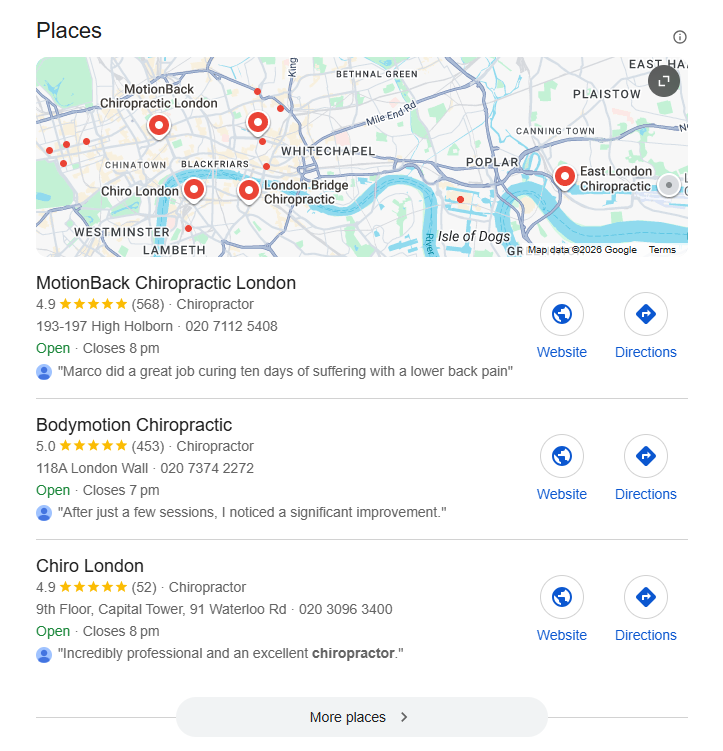
Why Local SEO Matters for Your Chiropractic Practice
Local search is where most patient journeys start. When someone needs pain relief from a back or neck problem, they want chiropractic care nearby. They’re not browsing nationally, they’re searching for a chiropractic practice that can see them soon.
SEO for chiropractors, specifically in a local context, is the only marketing channel that compounds over time. A well-optimised Google Business Profile and a structured chiropractic website keep attracting new patients around the clock, with no ongoing spend.
Chiropractor marketing includes Google Ads, social media, and word of mouth, all of them work when your Google Ads campaigns are set up and managed properly. But local SEO strategies are the only ones where your rankings keep improving after you stop actively working on them. For most UK chiropractic practices, local SEO is the highest-return long-term investment in bringing in more patients.
How Google Ranks Local Search Results
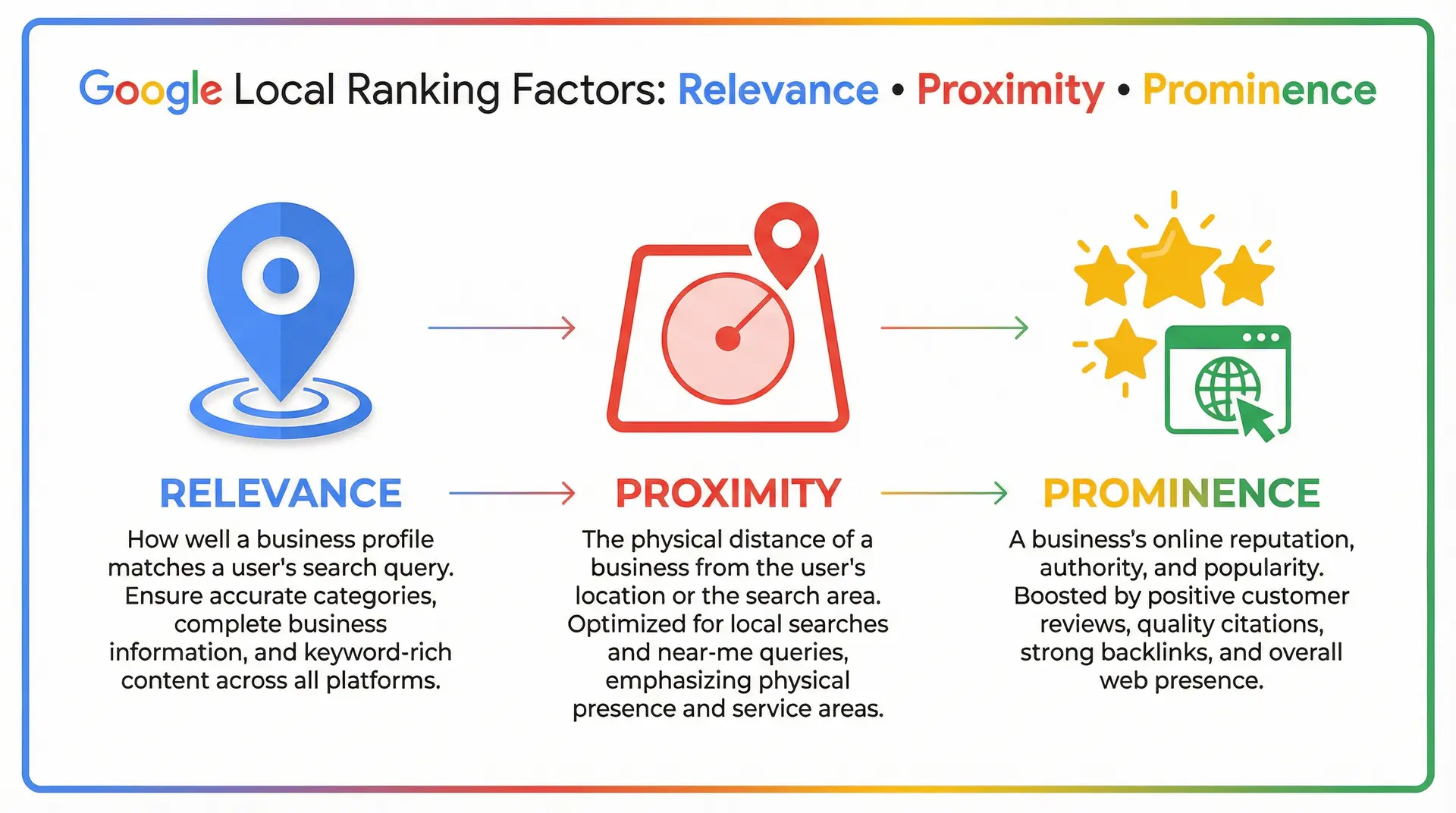
Google uses three factors to decide which chiropractors appear in local search results: proximity, relevance, and prominence. Understanding these is the foundation of any chiropractor SEO strategy.
Proximity is how close the searcher is to your practice. You can’t change this, but strong performance on the other two factors regularly overcomes a location disadvantage.
Relevance is whether search engines understand what your chiropractic practice does. Your Google Business Profile categories, your website content, and your schema markup all signal relevance. A homepage that says “we help you feel better” gives search engines almost nothing to match to a specific query.
Prominence is how well-known and trusted Google considers your practice to be. Reviews, citations, backlinks, and website authority all contribute. A chiropractic practice with 80 Google reviews and consistent listings across 15 UK directories regularly outranks a closer competitor with a sparse profile.
The map pack and organic search results are separate but connected. Your website’s strength affects how well your Google Business Profile ranks. Neglect one and you limit the other.
Optimising Your Google Business Profile
Your Google Business Profile is the single highest-impact element of local SEO for chiropractors. Before touching your chiropractic website, citations, or content, get this right.
Google Business Profile listings capture the largest share of local search clicks of any result type, making Google Business Profile optimization a non-negotiable first step.
When we audit a new chiropractic practice GBP, we almost always find the same cluster of issues: wrong primary category, half-empty service listings, and a Q&A section left entirely to chance. These are quick fixes that improve local search rankings within weeks.
[IMAGE: Annotated screenshot of a fully completed GBP listing for a chiropractic practice, with callouts on: primary category, services tab, Q&A section, and photo gallery]
Choose the Right Category
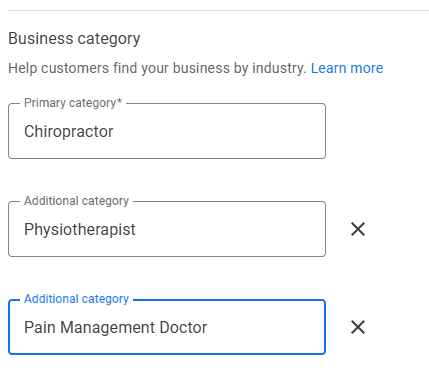
Your primary category must be Chiropractor, not “Alternative Health Service” or “Wellness Centre.” This is the most important field in your Google Business Profile, and the wrong choice makes you invisible for your most important search results.
Secondary categories worth adding where accurate: Physical Therapist, Sports Medicine Clinic, Pain Management Physician.
Complete Every Field
Your business name must match your legal trading name exactly. Your address must be identical across your Google Business Profile and every citation, minor formatting differences introduce inconsistency that weakens your local search authority.
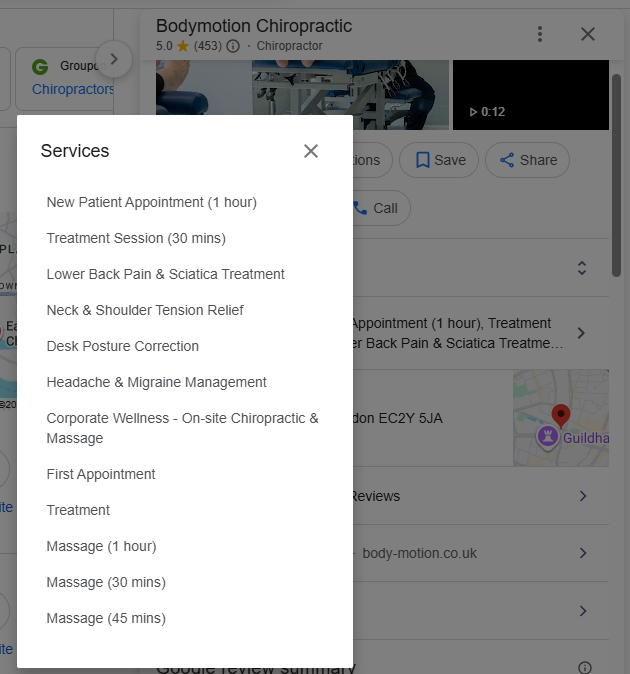
Keep opening hours current and add each treatment as a separate service with its own description. Search engines use service data to match your listing to specific treatment searches, so a blank services tab is a missed opportunity to rank higher for treatment-specific queries.
Upload Regular Photos
Your chiropractor Google Business Profile makes a first impression before patients search online and visit your website. Upload at least 10 to 15 photos and update them quarterly: exterior, reception, treatment room, and headshots of each practitioner.
UK Citation Building for Chiropractors
A citation is any online mention of your practice’s name, address, and phone number (NAP). Maintaining consistent NAP data across online directories is vital for local SEO performance, inconsistency dilutes your local search authority.
We’ve audited chiropractic practices that moved premises, updated their website, but left the old address live on seven directory sites for years, or simply got the naming conventions slightly wrong. Local search authority suffers as a result. A citation audit surfaces these issues, most practices don’t know they’re there.

Which UK Directories Matter
The online listings that matter most for UK chiropractic SEO:
- – Yell.com: essential; a primary UK citation source
- – Bing Places for Business: consistently underestimated
- – Apple Maps via Apple Business Connect
- – Doctify: healthcare-specific, trusted by potential patients comparing practitioners
- – British Chiropractic Association member directory, authoritative and sector-specific
- – Treatwell, Thomson Local, Facebook Business Page
How to Audit Your Citations
Search “[practice name] [town]” and check every result for accuracy. BrightLocal is the most practical tool for a systematic sweep. Fix inconsistencies before building new ones, adding accurate online listings on top of inaccurate existing ones, compounds the problem.
On-Page SEO for Your Chiropractic Website
Effective chiropractic SEO means a chiropractic website with specific pages for specific treatments and locations, structured so search engines can match your content to the right queries. A homepage alone is not enough.
Location and Treatment Pages
Service pages should include specific chiropractic services associated with geographic locations. A page targeting “Back Pain Relief in Leeds” or “Neck Pain Chiropractor Manchester” will consistently outrank a homepage that mentions those conditions in passing.
Use local keywords and location-specific keywords to signal to search engines that your chiropractic practice serves that specific area. For a single-location practice, build one page per treatment condition. For multiple locations, build a dedicated page per site.
Chiropractic keywords to target include condition-specific terms (“back pain relief”, “sciatica treatment”, “sports injury”) combined with your location. This is where keyword research into your local area pays off most.
Title Tags and Meta Descriptions
Title tag formula: [Treatment] Chiropractor in [City] | [Practice Name].
Meta descriptions don’t move search engine rankings directly, but they affect click-through rate from search results. Include the treatment, location, and a differentiator (“GCC registered”, “same-day appointments”) in every meta description. Better click-through rates from local search results are themselves a positive signal to search engines.
Technical SEO and Schema Markup
Technical SEO makes your chiropractic website easy for search engines to crawl and index, covering site speed, mobile performance, and structured data. For a chiropractic practice, use `MedicalClinic` schema alongside `LocalBusiness`, including your GCC registration number. Use Google’s Rich Results Test to verify implementation. Technical SEO issues are common SEO issues that quietly suppress rankings without obvious symptoms.
E-E-A-T and Google’s Health Content Standards
No other guide on chiropractic SEO covers this properly. It’s where many chiropractic practices quietly undermine their own local rankings.
Google classifies chiropractic content as YMYL (Your Money or Your Life), holding chiropractic websites to a higher editorial standard than most local businesses. Thin, uncredentialled content faces active ranking suppression in local search results.
Trust Signals Google Looks For
The E-E-A-T framework (Experience, Expertise, Authoritativeness, Trustworthiness) determines how Google rates your chiropractic website. Practical signals that matter:
- Practitioner qualifications and training institutions listed on your site
- GCC registration number on your About page, not buried in a footer
- Individual practitioner bios for each clinician
- Author attribution on any blog or local content
- References to credible sources: NHS guidance, peer-reviewed journals
As part of our process, we audit every chiropractor’s About page before starting local SEO work. If a potential patient can’t find out who will be treating them and what qualifications they hold, Google’s quality raters are forming the same conclusion.

GCC and ASA Advertising Compliance
The General Chiropractic Council and the ASA regulate all chiropractic marketing material. Blog posts, service pages, and your Google Business Profile description all fall within these standards. Make sure you check gcc-uk.org for more information.
You cannot claim to “cure” conditions. You can say treatments “may help with” specific complaints or that potential patients “commonly seek chiropractic care” for certain conditions. Practices that get this right build more trust with both search engines and local patients. Those that make overblown claims face ASA complaints and search rankings penalties, usually in quick succession.
Getting More Patient Reviews
According to BrightLocal’s Local Consumer Review Survey, 76% of consumers read online reviews before choosing a local business. For a chiropractic practice, patient reviews directly affect both trust and local search rankings.
Positive reviews improve click-through rates from search results and are a confirmed map pack ranking factor. Practices with more, newer, higher-rated Google reviews consistently rank higher than competitors with sparse online reputation signals.
How to Ask Compliantly
Ask in person after a positive appointment. Follow up via email or SMS with a direct link to your Google Business Profile review page. The ask should be simple: “We’d appreciate a Google review, it helps other local patients find us.”
When we speak to chiropractors, it’s always a relief when they already have a review collection process. The practices that generate patient reviews consistently are the ones that make it effortless. A QR code at reception linking directly to the review page, and a brief verbal ask at the end of a session. Encourage satisfied patients this way, and the results compound quickly.
Do not offer incentives – the GCC prohibits this; Google bans it separately. Do not send bulk request reviews messages to your entire patient list at once, as sudden spikes trigger Google’s review filter.

Responding to Reviews
Respond to every review. Thank satisfied patients for positive ones without referencing specific treatments (patient confidentiality applies). For negative reviews: acknowledge, don’t defend, resolve offline. Every response signals an active chiropractic practice and search engines read it that way.Yes

How Long Does Local SEO Take?
Local SEO is an ongoing effort, not a one-time task, and the same is true for SEO for small businesses looking to grow organic traffic. Realistic timelines:
– GBP optimisation: visible improvement in map pack position within 4–8 weeks
– Citation building: 6–10 weeks for new listings to be indexed
– Organic search rankings: 3–6 months of consistent effort for competitive local search terms
– Patient reviews: cumulative, more local patients come from a consistent review pipeline built over time
Rank higher across all these signals by treating local SEO as a continuous commitment. The SEO strategies that work are the ones applied consistently over 6–12 months, not bursts of activity. Most chiropractic practices that see strong results treat local SEO strategies as an ongoing programme, not a project.
If you’d rather hand this off while you focus on chiropractic care, consider affordable digital marketing for chiropractors covering SEO and Google Ads, or get in touch for a free local SEO audit, we’ll tell you exactly where the gaps are.
Ready to Get Your Practice Found?
Local SEO for chiropractors comes down to seven things done consistently: a fully optimised Google Business Profile, accurate citations across UK directories, well-structured service pages targeting local search, technical SEO, strong E-E-A-T signals, a steady patient reviews pipeline, and GCC-compliant content.
Most of your competitors aren’t applying these SEO strategies consistently. That’s exactly why there’s still room to rank higher in your area and attract more patients from local search.
We offer a free local SEO audit for UK chiropractic practices, similar in depth to a comprehensive SEO audit that uncovers technical, content, and backlink issues. We’ll review your GBP, citation profile, and chiropractic website, and show you exactly what’s holding your local search rankings back.
Book your free local SEO audit.
Frequently Asked Questions
How much does local SEO cost for a chiropractor in the UK?
A: Ongoing local SEO management typically runs between £500 and £1,500 per month for a solo or small chiropractic practice. One-off audits cost less, and many clinics look for affordable SEO services with a clear checklist of what’s included. Compare this against cost-per-new-patient from Google Ads to get a realistic picture of the return, and set expectations using typical SEO costs in the UK and what they include.
What are the red flags when hiring an SEO agency for your chiropractic practice?
Watch for agencies that guarantee specific search rankings (no one can), use vague language about improving your online reputation without specifics, ignore the GCC compliance angle entirely, or promise results in weeks. Understanding what an SEO company actually does and the services they provide makes it easier to spot red flags. Good SEO for chiropractors takes months. Anyone claiming otherwise is overselling.
Do Google Ads work for chiropractors?
Yes, but they stop the moment you stop paying. Google Ads on chiropractic terms can run £5–15 per click, making them expensive for attracting local patients at scale unless they’re structured around high‑intent PPC campaigns that convert efficiently. Local SEO compounds over time; ads don’t. Most chiropractic practices benefit from both, local SEO as the long-term foundation, ads used tactically for specific promotions.
How do I get my practice to appear in Google Maps?
Claim your Google Business Profile and complete every field. Choose “Chiropractor” as your primary category, build consistent NAP across UK online directories, and build a steady flow of genuine patient reviews. There is no shortcut but the sequence is clear.
Does my website matter if my GBP looks good?
Yes, significantly. Your chiropractic website is Google’s trust signal for your Google Business Profile. A slow or thin site limits how well your map listing can rank higher in local search results. Both need to work together, and many practices benefit from partnering with an SEO agency to manage this work long term.
How many new patients can local SEO bring in?
It varies by location and how well your site converts website visitors into bookings. Local SEO brings in new patients by increasing the volume of potential patients who find you; converting them depends on your site, your online reputation, and your online reviews. Most chiropractic practices see a meaningful increase in phone calls and enquiries within 3–6 months of consistent effort.
How do I get my chiropractic practice to appear in Google Maps?
A: Claim and fully complete your Google Business Profile, choosing “Chiropractor” as your primary category. Build consistent citations across UK directories including Yell, Doctify, and Bing Places. Generate a steady flow of genuine patient reviews.
What is the 80/20 rule for local SEO?
A: In local SEO for chiropractors, your Google Business Profile and patient reviews drive the majority of ranking results. Get these right first before investing heavily in content, technical SEO, or citations, those amplify a strong foundation rather than build one. From there, many clinics move onto structured SEO packages that cover audits, on-site and off-site optimisation.
What claims can chiropractors make in their SEO content?
The GCC and ASA regulate all chiropractic marketing, including website and blog content. You cannot claim to “cure” conditions. You can say treatments “may help with” specific complaints and that patients “commonly seek chiropractic care” for certain conditions. Always cite credible sources for health claims.
