
SEO for Plumbers: How to Get More Local Customers

Most plumbing jobs still come through word of mouth. The problem is, word of mouth doesn’t work at 10pm on a Sunday when someone’s boiler has packed in and they don’t know a single plumber.
That’s where SEO for plumbers comes in. Search engine optimisation (SEO) is the process of getting your plumbing business found on Google when local customers are actively searching for what you offer. Done well, it means your phone rings from people who found you at exactly the right moment, not because a friend remembered your name, but because Google showed you first.
This guide covers what plumber SEO actually means, not in theory, but in practice. We’ll cover the three pillars every plumbing business needs to understand, the specific actions that move the needle, and how to build online visibility that keeps working whether you’re on a job or in bed.
What Is SEO for Plumbers?
SEO for plumbers is how you get your plumbing business to appear higher in search engine results when someone nearby searches for a plumber.
For a plumbing business, local SEO is what matters most. You’re not trying to rank nationally — you’re trying to rank in your town, your service area, your patch. A homeowner in Leeds searching “emergency plumber” needs to see a plumber who actually covers Leeds, not a plumbing company based three hours away.
Google uses three main signals to decide which local businesses to show:
- Relevance — does your plumbing business offer what the person is searching for?
- Proximity — are you geographically close to the person searching?
- Prominence — do other websites, directories, and reviews signal that you’re a trusted, established business?
Local SEO for plumbers is about feeding all three signals. Everything in this guide — your Google Business Profile, your service pages, your reviews — feeds into relevance, proximity, or prominence. Usually more than one at a time.
Why SEO Matters for Your Plumbing Business
When a pipe bursts or a boiler stops working, most people reach for their phone and search Google. These are high-intent local searches, the person isn’t browsing, they’re ready to call whoever looks most credible in the next 60 seconds.
Searches like “emergency plumber near me”, “boiler not working”, and “burst pipe repair” happen thousands of times a day across the UK. Nearly 90% of plumbing searches happen on mobile devices, often from potential customers mid-emergency with no time to browse. If your plumbing website isn’t appearing in those results, you’re invisible to customers who are actively trying to hire you.
Word of mouth has a ceiling. A good SEO strategy doesn’t. A well-optimised plumbing website works at midnight on a bank holiday. No referral network does that.
When a plumber first comes to us, the situation is almost always the same, a Google Business Profile that was set up years ago, never touched since, sitting on 6 reviews and a 4-star average. That alone is costing them jobs every single week.
The Three Pillars of SEO – and What They Mean for Plumbers
At Dandy, we build all our SEO strategies on ore three pillars: technical, content, and links, the same framework that underpins our work as an affordable SEO agency for small businesses.
You may also see these described as on-site SEO (technical and content — everything on your plumbing website itself) and off-site SEO (the links and authority signals that come from other websites). Both matter, and neglecting either will limit your search engine rankings regardless of how strong the other is.
For a local plumbing business, specific tactics sit inside each pillar. Your Google Business Profile is a content signal. Your Checkatrade listing is a link. Your mobile-friendly website is technical. Once you understand the framework, every piece of SEO advice from any SEO agency or digital marketing guide should hopefully makes more sense.
Pillar 1 – Technical SEO: Getting Your Foundations Right
Technical SEO sounds more intimidating than it is. For most plumbing websites, a handful of checks cover the vast majority of what matters and most can be resolved without touching a line of code.
Mobile-Friendly Website
The majority of plumbing searches will occur on mobile devices — potential customers standing in their hallway at 11pm, not sitting at a desktop. Your plumbing website must work flawlessly on a phone.
Google uses mobile-first indexing, meaning it looks at your mobile site to decide where to rank you in search results. If your plumbing website is awkward to use on a phone — text that requires zooming, buttons that miss when tapped, a phone number you can’t click to call — Google notices, and so will your potential customers.
If you’ve had an website design agency, or even just bought a WordPress theme this should be covered, but its always worth checking how your website and key landing pages appear on mobile.
The quickest check: open your website on your own phone and try to find your number and contact page. If it feels frustrating, it needs fixing before anything else.
Page Speed, HTTPS, and Site Structure
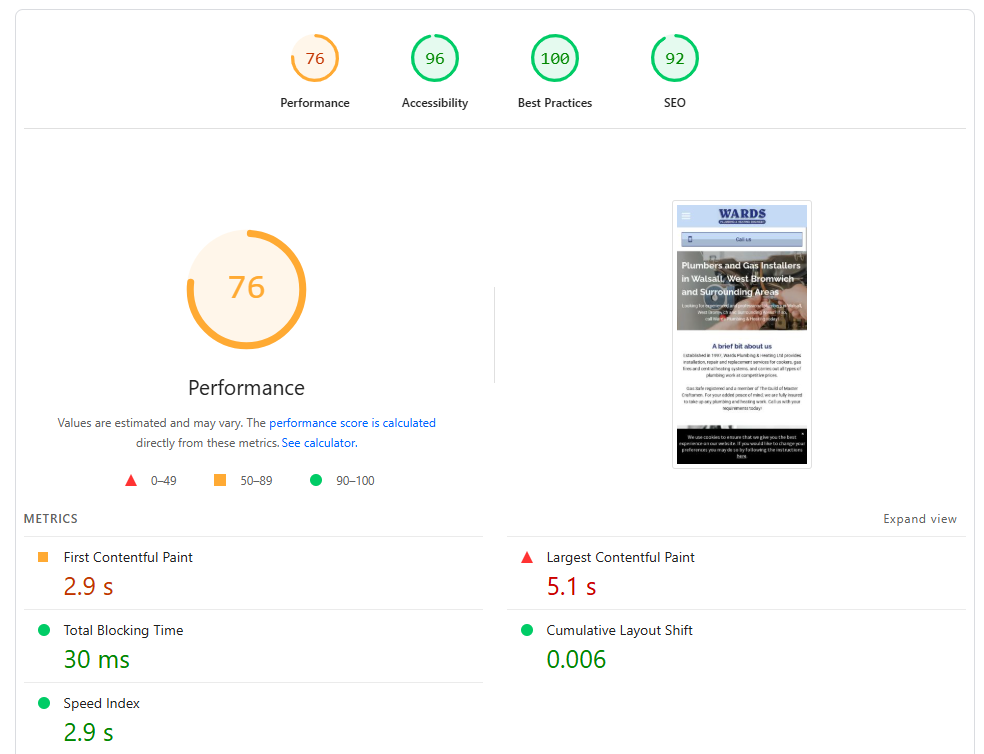
A slow website loses visitors before they’ve read a single word. Most people abandon a page that takes more than three seconds to load. You can check your plumbing website’s speed for free using Google PageSpeed Insights, it gives you a score and tells you exactly what to fix.
HTTPS is non-negotiable. If your website doesn’t show a padlock in the browser bar, Google treats it as insecure and ranks it lower. Most hosting providers include a free SSL certificate, if yours doesn’t, it’s worth switching.
Site structure should be logical: homepage and service pages through to location pages. Google follows links to discover your content. A service page buried three clicks deep is unlikely to rank in search engine results.
Local Business Schema Markup
Schema markup is a small piece of code that tells Google exactly who you are — your business name, address, phone number, opening hours, and service area. Think of it as a structured business card that Google can read automatically, without having to guess.
Most website platforms — WordPress, Wix, Squarespace — have plugins or built-in tools that add this without any coding. If you’re not sure whether your plumbing website has it, ask your web developer or run your URL through Google’s free Rich Results Test.
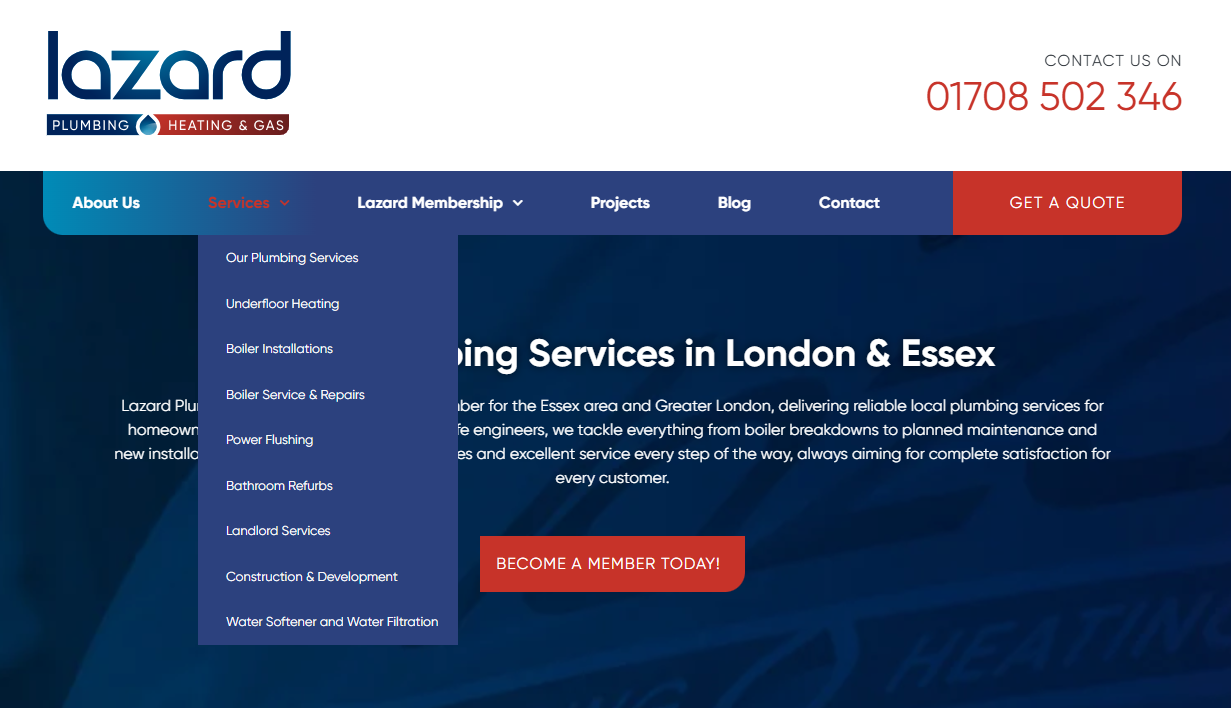
This is where things might get slightly too technical but you can build custom schema, and even use the specific “plumber” type.
Tracking Your Performance with Google Analytics and Search Console
Two free tools every plumbing business should set up before doing anything else: Google Search Console and Google Analytics.
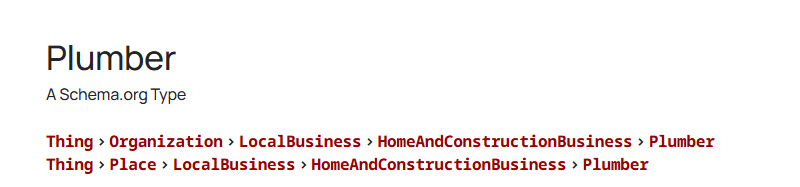
Google Search Console shows you exactly which search queries are bringing people to your plumbing website — or nearly bringing them. It tells you which pages are appearing in search results, what position they’re in, and how many clicks they’re generating. It’s the most direct window into how your SEO efforts are performing.
Google Analytics shows you what visitors do once they arrive — which pages they visit, how long they stay, whether they contact you. Together, these tools tell you what’s working and what isn’t, so your SEO strategy can be based on data rather than guesswork.
Both are free, both take under 30 minutes to set up, and both are essential for tracking whether your plumber SEO is actually driving more leads.
Pillar 2 – Content: Telling Google What You Do and Where
Content is the on-site SEO side of your plumbing website — the pages and information that tell Google which plumbing services you offer and which areas you cover. For a plumber, this means three types: your Google Business Profile, your service pages, and your location pages (also called service area pages). Each targets a different aspect of local search results, and you need all three working together.
Setting Up Your Google Business Profile
Your Google Business Profile (GBP) is a free listing that controls how your plumbing business appears in Google Maps and the Local Pack — those three results with a map that appear above everything else when someone searches for local plumbing services. It is consistently the single most important asset for local search rankings.
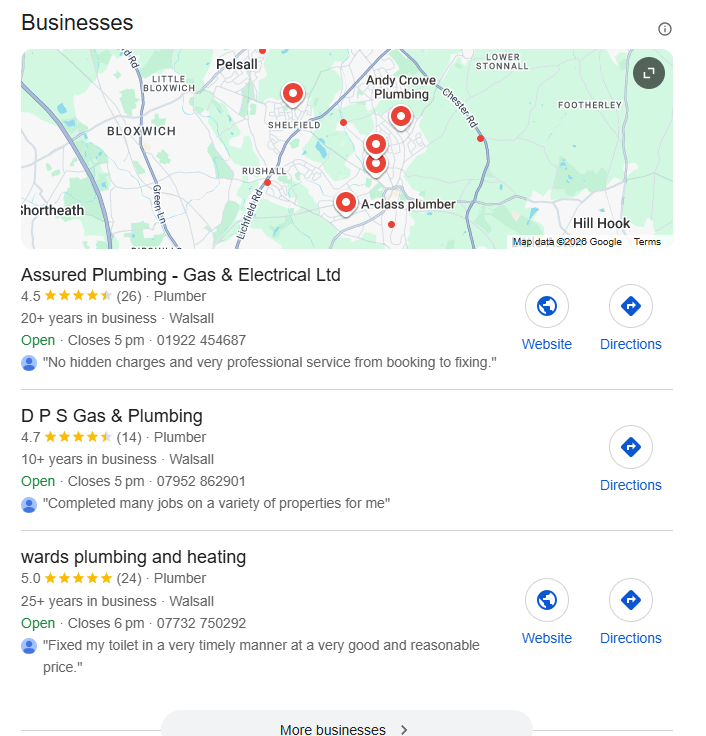
To set it up or claim it:
- Go to business.google.com — search for your business name. If it already exists, claim it. If not, create it from scratch.
- Set your primary category to Plumber. Add secondary categories that apply: Emergency Plumber, Heating Contractor, Gas Engineer, Bathroom Remodeller.
- Add your service area — list every town and area you cover, not just your postcode. You can add up to 20 areas.
- Complete every available field: phone number, website URL, opening hours (including whether you take emergency callouts), and a business description that naturally mentions your plumbing services and location.
GBP is consistently the fastest win we see for trades businesses. Its one of the first things we look at when we get a plumbing client.
We’ve had plumbers go from zero Map Pack visibility to a consistent top-three position relatively quickly. Just from completing the profile properly, adding photos regularly, and getting a run of reviews in. No website changes, no link building.
Optimising Your Profile for the Map Pack
Once your profile is claimed and complete, these steps improve its local search rankings:
- Upload at least 10 photos — your van, your team, completed jobs (before and after, with customer permission). Profiles with regular photo uploads consistently appear more often in local search results.
- Use the Services section to list every individual plumbing service, each with its own short description.
- Add a GBP post at least once a week — a recent job, a seasonal reminder (“time to get your boiler serviced before the cold hits”), or a short offer.
- Populate the Q&A section with the questions potential customers typically ask, and answer them yourself before anyone else does.
- Ensure your NAP (Name, Address, Phone) is identical across your plumbing website, GBP profile, and every directory listing. Even small differences — “St.” vs “Street” — can dilute your local search rankings.
Service Pages – One Page Per Service
When we audit a plumber’s website for the first time, around 90% have a single Services page listing everything they do — boiler installation, drain unblocking, bathroom fitting, the lot — all on one page. That one page is trying to rank for 15 different searches at once. It can’t. Splitting those out into individual pages is usually the change that produces the most visible improvement in search engine rankings.
A single “Services” page that lists everything your plumbing business offers is not enough. Google needs a dedicated page for each service to understand exactly what you do and rank you when someone searches for it specifically.
One plumbing website page cannot rank for “boiler installation Leeds”, “drain unblocking Leeds”, and “emergency plumber Leeds” simultaneously. Each of those local searches needs its own page to compete for it.
Here’s a definitive list of service pages most plumbing businesses should have:
- Emergency plumber
- Boiler installation
- Boiler repair and breakdown
- Annual boiler service
- Central heating installation
- Power flushing
- Bathroom installation
- Drain unblocking and cleaning
- Leak detection and repair
- Radiator installation
If a potential customer has ever searched specifically for it, it needs its own page. Keyword research helps here: type your plumbing services into Google autocomplete and see what local customers are actually searching for in your area.
What to Put on Each Service Page
If you’re not confident writing SEO-friendly copy yourself, you can follow guidance on how to write effective SEO content so each page is both useful for customers and optimised for search.
Each service page on your plumbing website should include:
- An H1 heading that includes the service name and your primary location (e.g. “Boiler Repair in Leeds”)
- At least 300 words of genuine, useful content — what’s involved, what to expect, how long it takes, rough pricing if you’re comfortable sharing it
- Meta descriptions for every page — a 155-character summary that includes your target keyword and gives searchers a reason to click
- A clickable phone number above the fold — visible without scrolling
- Customer testimonials relevant to that specific plumbing service
- Photos of relevant completed work
- An internal link to related location pages
If building these pages sounds like a significant undertaking, our SEO packages for tradespeople include exactly this — service pages planned, written, and optimised as part of the engagement, with the same structure as our broader affordable SEO packages for small businesses.
Location Pages – Rank in Every Town You Cover
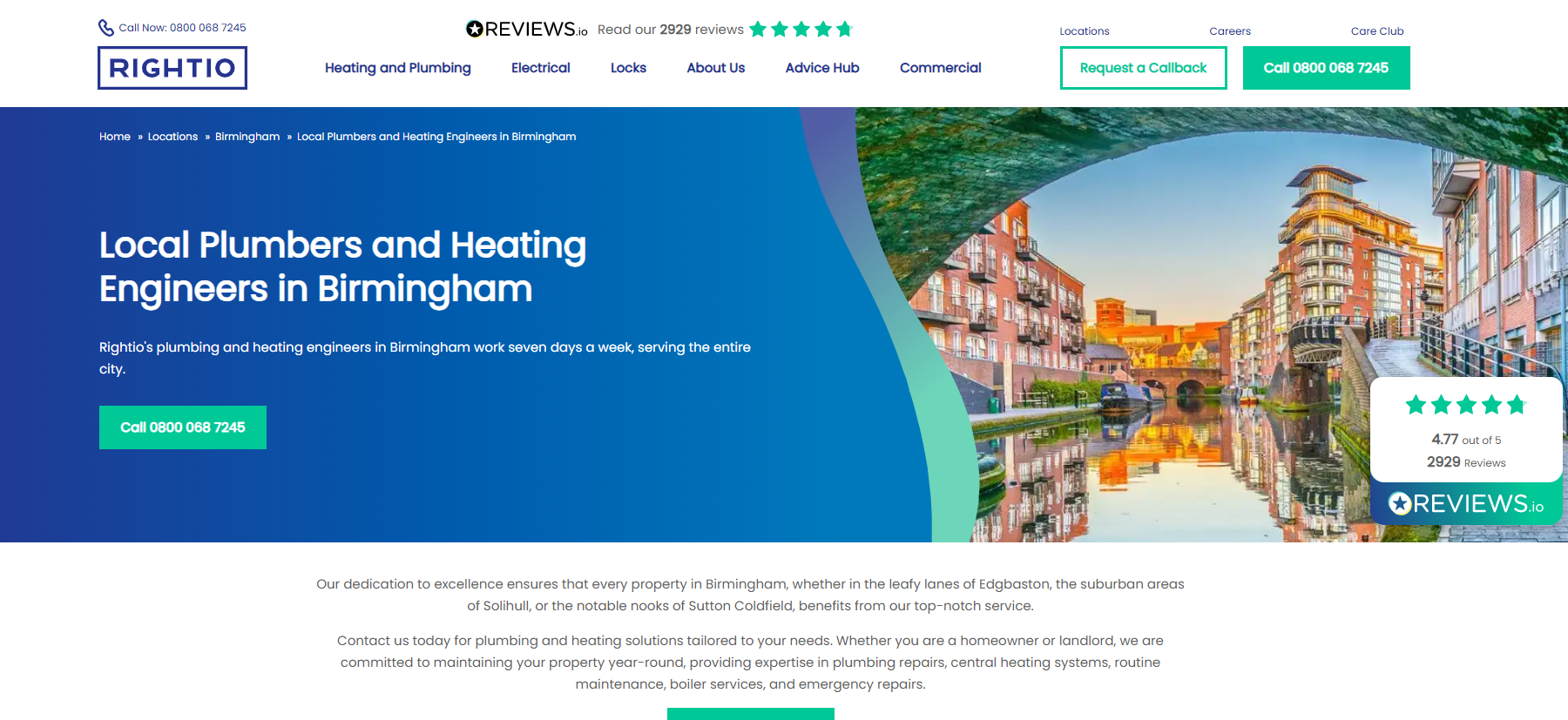
A location page (also called a service area page) targets “[service] in [town]” searches — “Plumber in Sheffield”, “Emergency Plumber in Leeds”, “Boiler Repair in Bradford”.
A line on your plumbing website saying “we cover the whole of Yorkshire” will not rank you in Leeds. Google needs a dedicated page for each area you want to attract local customers from.
The cardinal rule: every location page must be genuinely different. Copy-pasting the same content and swapping the town name is thin content — Google detects it and it does more harm than good.
What makes a strong location page:
- An H1 that includes the service and location
- References to specific neighbourhoods and local areas — shows Google you genuinely work there
- Customer testimonials from customers in that specific location
- A Google Maps embed of the area
- A clickable phone number — local customers want to call, not fill in a form
How Many Location Pages Do You Need?
Start with your top three to five service areas and build outward as your plumbing business grows. Five well-written location pages will consistently outrank fifty thin ones.
The highest-performing format: “[Service] in [City]” — combining service intent with location. “Emergency Plumber in Leeds” is more specific and less competitive than either term alone, making it easier to rank for and more likely to convert potential customers into calls.
Pillar 3 – Links: Building Your Authority Online
Links from other websites tell Google your plumbing business is real, active, and worth trusting. This is the off-site SEO side of your plumber SEO strategy and sits alongside the broader digital marketing work covered on our SEO and digital marketing blog. For a local plumber, two types matter most: directory citations and Google reviews.
UK Directory Listings and Citations
A citation is any mention of your plumbing business — name, address, and phone number — on another website. Each one is a signal to Google that you’re a legitimate, established business at a specific location.
UK directories worth prioritising for plumbing businesses:
- Checkatrade: strong domain authority and trusted by UK homeowners
- Which? Trusted Traders: carries particular weight with older demographics
- Rated People: high traffic from people actively seeking tradespeople
- Yell.com: one of the most-established UK business directories
- Gas Safe Register: if you’re gas registered, this listing carries significant weight and reinforces your credentials to both Google and potential customers
- Local bloggers: Identify and work with local bloggers to build local links
- Local sponsorship: again local links will really help you beat the competition, if there are any local sponsorship opportunities that will give a link back to your website, they would be perfect.
Your NAP must be identical on every listing. “J Smith Plumbing Ltd” and “J. Smith Plumbing” look like two different businesses to Google, and inconsistency dilutes your local authority.
A small number of strong, reputable directories will do more for your local SEO than hundreds of low-quality ones. Listing your plumbing business on social media platforms — a Facebook business page, for example — also functions as a citation and reinforces your local presence.
Google Reviews: The Link Between Trust and Rankings
Online reviews are a confirmed local ranking factor. More high-quality reviews correlate directly with higher Map Pack positions — and a stronger star rating drives significantly more calls at the same search engine ranking position. BrightLocal’s Local Consumer Review Survey consistently finds that most people won’t contact a plumbing business with fewer than four stars.
The competitive benchmark for most UK markets: 50 or more real customer reviews at 4.5 stars or above.
How to Ask for Reviews
The best moment to ask: right after you finish a job, while the customer is happy and you’re still on site. Send a follow-up text with a direct link to your Google review page — you can generate this from your GBP dashboard under “Get more reviews”.
Add that link as a QR code on your invoices and business cards. The customer can scan it while you’re packing up, which removes almost all the friction.
A simple script that works: “If you were happy with the work, a Google review really helps us out — I’ll send you the link now.”
Never offer incentives — discounts, a free callout — in exchange for a review. It violates Google’s policies and risks getting your profile suspended.
How to Respond to Reviews
Respond to every review within 48 hours, positive or negative. Responding is a local ranking signal — Google sees an engaged, active plumbing business.
For positive reviews: thank them and mention the specific job and location naturally. “Glad we could sort the boiler repair in Harrogate quickly — appreciate you taking the time.” Including the plumbing service and location in your response reinforces those keyword signals without feeling forced.
For negative reviews: stay calm, acknowledge the issue, and take it offline. “We’re sorry to hear this — please give us a call and we’ll make it right.” Never argue publicly, regardless of whether the complaint is fair.
Quality Backlinks and Off-Site SEO
For most plumbers at the start of their SEO journey, directory citations and real customer reviews are enough. As your plumbing business grows, quality backlinks from reputable sources help build further authority:
- Local press coverage — appearing in a local news article often includes a website link
- Trade association memberships — Gas Safe, CIPHE, and APHC include directory listings with links back to member websites
- Manufacturer or supplier websites — some list approved installers, which can include a link to your site
Don’t chase backlinks aggressively in the early stages. Get the citation foundations solid first.
Supporting Blog Content — How to Build Topical Authority
Google doesn’t just rank individual pages — it ranks plumbing websites it considers authoritative on a topic. A plumber whose website covers plumbing thoroughly and helpfully will, over time, outrank one whose site has only a homepage and a contact form. This is called topical authority, and it’s built through consistent, useful blog content that supports your main service and service area pages.
What Is E-E-A-T and Why Does It Matter?
Google evaluates the quality of your content using E-E-A-T — Experience, Expertise, Authoritativeness, and Trustworthiness. For a plumbing business, this means writing from real experience, demonstrating genuine technical knowledge, earning mentions on credible sites, and giving potential customers every reason to trust you. Show your Gas Safe registration. Share real job examples. Give honest information rather than vague generalities.

Blog Post Ideas for Plumbing Businesses
Blog content that works well for plumbing businesses, based on what local customers are actually searching for:
- “How to bleed a radiator” — one of the most-searched plumbing questions in the UK. Answering it positions you as helpful before anyone has needed to hire you.
- “Signs your boiler needs replacing” — catches potential customers at the research stage, before they’re actively searching for a plumber.
- “How much does a new boiler cost in the UK?” — high search volume, and a plumbing business that answers this honestly earns trust immediately.
- “Combi boiler vs system boiler: which is right for your home?” — positions you as an advisor, not just a tradesperson.
- “What is power flushing and do I need it?” — supports your power flushing service page and targets a question customers frequently ask before booking.
- “How to find a Gas Safe registered plumber” — reinforces your own credentials whilst targeting a trust-based search.
Each blog post should link internally to the most relevant plumbing service page. A post about boiler costs links to your boiler installation page. A post about power flushing links to your power flushing service page. Keyword research will help you find additional topics your local customers are searching for beyond these starting points.
The plumbers who see the biggest long-term results treat their plumbing website like a resource, not a brochure. Keep you blog posts focused on just honest answers to questions you get asked on jobs, validate these with keyword research, write an answer showcasing your expertise, and follow best practices for using blogging to improve SEO. Job done.
How Long Does Plumber SEO Take?
Quick Wins vs Long-Term Results
There’s no overnight fix, and anyone who tells you otherwise isn’t being straight with you.
Google Business Profile and online reviews show results fastest. Plumbers who actively optimise their GBP and build up reviews consistently can start seeing Map Pack movement within a matter of weeks. It’s the highest-impact, lowest-cost starting point on this list — and you can begin today at no cost.
Website SEO — service pages, location pages, technical foundations — typically takes three to six months to build momentum, and six to twelve months to compound properly. That’s not a reason to delay starting. The earlier you begin, the earlier the improved search engine rankings compound.
SEO is cumulative. A page at position 8 today will climb as it earns more signals. The plumbing businesses ranking well in two years are the ones who started two years ago.
Where to Start and When to Get Help
The 80/20 Rule Applied to Plumber SEO
The 80/20 rule in digital marketing means roughly 20% of actions drive 80% of results. For a plumbing business, those high-impact actions are: a fully optimised Google Business Profile, a steady stream of real customer reviews, and individual service pages for your core plumbing services. Everything else — advanced link building, social media platforms, technical schema — compounds on top of that foundation.
Start there. Do it well. Then build outward.
How Much Does SEO Cost for Plumbers?
Local SEO services for UK plumbing businesses typically cost between £350 and £850 per month. This usually covers Google Business Profile management, on-site SEO for your plumbing website, citation building, and performance reporting via Google Analytics and Google Search Console, and follows the same core principles as SEO for small businesses in other sectors.
One-off work — such as building out a set of service pages or running an SEO audit — is typically charged at a day rate. Most plumbing businesses see a return on their SEO investment within three to six months once local search rankings start to improve and review volume builds.
Much of what’s in this guide costs nothing but time. Claiming your Google Business Profile, asking for reviews after every job, and getting listed on Checkatrade and the Gas Safe Register are all free.
The harder lift is your plumbing website. Building proper service pages and location pages, getting the technical foundations right, and publishing consistent quality content takes time and sustained effort that most plumbing business owners understandably don’t have between jobs.
Most trades businesses we work with start with the free basics, see early results, then bring us in when they want to scale — or when they decide their time is better spent on the tools than on Google. At that point it often makes sense to work with a specialist partner and understand exactly what an SEO company does for you behind the scenes.
If you’d rather focus on the plumbing and let us handle the SEO, take a look at our SEO services or see our SEO packages to find out exactly what we do and what it costs.
