
SaaS SEO Strategy: How 15 Experts Outrank The Competition

SaaS marketing teams often struggle with stagnant organic traffic, content that fails to convert despite rankings, and strategies outdated by AI search shifts and algorithm changes like Google’s 2026 core updates. Trying to win at ranking for the broadest most generic keywords and pages that once drove the majority of online traffic? That might not be your best bet anymore.
Our 2026 survey of 15 SaaS SEO experts uncovers proven tactics (from use case libraries to product-led flows) that drive signups and PQLs, not vanity metrics.
Explore our SEO services to get your SaaS site ranking and converting
How We Gathered This Data
In this 2026 survey, we asked experts in SEO and SaaS their professional opinions on the following topics:
- How has SaaS SEO evolved in 2026? What are the major changes in strategy impacting SaaS brands this year?
- What are the most effective SEO tactics for driving high-intent traffic, signups, and product-qualified leads for SaaS in 2026?
- What common mistakes or outdated SEO practices should SaaS companies avoid in 2026?
Here’s what they had to say…
15 Expert Insights Into SaaS SEO Strategy (2026 Survey Data)
Invest in Being Cited by AI Search
“We also invest in getting cited by AI search, not just ranked on Google.”
— Ameer Draidy, SEO Expert @ Circular Design
Dandy’s take: Ameer captures the emerging reality: AI Overviews and AI engines now represent a parallel discovery layer. Being structurally and reputationally “citable” is becoming as important as being rankable in traditional SERPs. So, ensuring suitability for AI ranking has become one of the biggest shifts in SaaS SEO for 2026 and beyond.
Discover our GEO services, built for ranking in AI engines
Use Case Libraries Beat Old Solutions Pages
“The most effective tactic for us has been using use case libraries- a use case library now outdoes the previous solutions page. We focus on X for [Industry] with [Integration], and these are our top-performing pages. They are long-tail queries that AI agents scrape to provide recommendations.”
— Sergey Galanin, SEO Director @ Phonexa
Dandy’s take: Sergey is crystal clear that vague “solutions” pages are losing ground to specific, long‑tail use case libraries. Pages are winning in search and are the organisation’s primary data source for content used in AI-powered job recommendations.
SEO Is No Longer Just a Marketing Task
“For SaaS companies, this means SEO is no longer just a marketing task. It requires collaboration across product, engineering, and customer success to produce content that actually reflects how the technology works.”
— Dirk Alshuth, CMO @ emma
Dandy’s take: Dirk’s point reframes SEO as a cross‑functional discipline. If marketing is writing in isolation, your content will always lag behind what engineers, product, and CS know about real‑world usage, and technical buyers will feel that gap immediately.
Focus on Real Vendor Evaluation Questions
“One tactic that works extremely well is building content around real questions buyers ask during vendor evaluation. Things like implementation challenges, pricing models, compliance requirements, or integration questions tend to attract people who are already deep in the buying process.”
— Colleen Barry, Head of Marketing @ Ketch
Dandy’s take: Colleen is pointing you straight at decision‑stage search. Search volume may not look crazy in tools, but the intent is high as people are shopping around, comparing different options to find the right product to meet their needs.
Let Readers Open Templates Inside the Builder
“Finally, connecting content with the product experience matters a lot. For example, letting readers open a template directly inside the builder can turn an SEO visit into a product signup very quickly.”
— Monica Panait, CMO @ Brizy
Dandy’s take: Monica’s example shows what product‑led SEO looks like in practice. Monica’s content is superb and she ends with “try this template now” and you can literally go direct into the product from her blog post.
Optimise Onboarding and Help Content for Search
“I’ve also seen strong results from optimising onboarding resources and help content for search, because people often search for tutorials and implementation steps while evaluating tools.”
— Kristiyan Yankov, Co-Founder & Growth Marketer @ Above Apex
Dandy’s take: Kristiyan highlights a blind spot for most SaaS teams: docs and onboarding live in product, so they rarely get SEO love. Docs and onboarding are put away in product and get zero SEO love, but those are exactly the pages your future customers would be searching for if they were to type something like “this specific feature is easy to use” or “does your product work for my industry”.
Don’t Let Content Sound Like It Was Written Only by Marketing
“One mistake I still see often is creating SEO content that feels disconnected from real industry experience. If the content sounds like it was written only from a marketing perspective, professionals quickly lose interest.”
— Lee Evans, Head of Marketing @ Outbuild
Dandy’s take: Lee’s warning is especially relevant in specialist verticals like construction tech. You may notice that the language, the constraints and the realities of the day job don’t appear in the copy written for your site.
Connect SEO Directly to Attribution and Customer Journeys
“If you don’t connect organic traffic with attribution and customer journeys, you’re missing the real picture of how SEO contributes to growth.”
— Konstantin Vashkevich, Head of Marketing @ Redtrack.io
Dandy’s take: Konstantin is right that traffic without attribution is vanity. But once you tie organic traffic to trials, demos and closed won, you can see what topics and page types are actually driving revenue vs. which ones just look good on monthly reports.
Fix Conversion Tracking Before Scaling SEO
“Mistakes to avoid in 2026: treating low-value actions as primary conversions, or letting tags break when the site changes (I see this constantly when performance drops).”
— Rusty Rich, President/Founder @ Latitude Park
Dandy’s take: Rusty’s seen what happens when tracking rots under the hood. Optimising the wrong pages for SEO is easy if you’re just optimising for newsletter sign ups or generic page views – which are the sorts of easy to track value actions that SaaS SEO efforts are wont to start with. First you need to build a solid, rigid foundation of tight tracking of real value actions.
Build Bottom-Funnel Clusters With One Primary Action
“Most effective tactics for PQLs: build bottom-funnel clusters and wire them to one clear next step. Example from our lead-gen playbook: create/use-case landing pages with integrated CTAs, social proof (testimonials/case studies), and “reduce-choice” layouts (one primary action), then use long-tail keywords + strong metadata + internal links to pull people into that conversion path.
We also pair this with simple automation (email dripping/lead nurturing) so a “not ready today” visitor becomes a qualified conversation later.”
— Steve Taormino, Founder and CEO @ CC&A Strategic Media
Dandy’s take: Steve’s “reduce‑choice” layout is the antidote to cluttered SaaS pages. Much smarter than the usual SaaS landing page sprawl of features, and instead presents one use case, one call to action, and one natural next step supported by data/proof for the high‑intent visitor to become a PQL or SQL quickly.
Map “Task → Template → Sandbox” Flows to Activation
“For high-intent traffic and PQLs, map content to activation moments: create “task → template → sandbox” flows (e.g., a how-to page that links directly to a one-click demo or pre-filled trial). Instrument content for PQL signals: track demo launches, API calls, or trial configuration as downstream metrics, not just conversions.”
— Pavankumar Kamat, Co-Founder and CEO @ Panto AI Inc.
Dandy’s take: Pavankumar reframes SEO pages as the opening of a product journey, not the end of a content journey. How-to pages can turn into measurable activation paths: how-to → template → sandbox.
Build Role- and Use-Case-Specific Landing Pages
“Instead of one generic product page, we build pages for “operations teams in logistics,” “revops in B2B SaaS,” etc, then map content: problems, product fit, onboarding outline, and 1–2 proof points. These pages tend to generate trial and demo requests at a far higher rate than blog posts.”
— David Hunt, Chief Operating Officer @ Versys Media
Dandy’s take: David shows how specificity wins. This page was targeted to lead responsible for RevOps and shows the targeted language, problems, and onboarding steps the ops manager responsible for logistics would go through before deciding to Book a Demo.
Turn SEO Into Pipelines, Not Vanity Metrics
“SEO aligned with product onboarding and customer journey is another powerful approach that helps to filter out low-value traffic and attract users ready to interact with the business. It turns SEO campaigns into pipelines and sales drivers, not a channel that generates vanity metrics.”
— Mark Voronov, Co-Founder & CEO @ Uproas
Dandy’s take: Mark’s framing is a helpful litmus test: if a topic or page can’t be tied to a real stage in your customer journey, it probably shouldn’t be an SEO priority. Is your content relevant to the key stages in your customers’ journey?
Let Jobs-to-Be-Done Drive SEO, Not Just Keywords
““SEO driven by programmatic job-to-be-done search query analysis – not product features, not keywords, but specific user tasks – is beating traditional keyword-focused content optimization efforts by a wide margin this year.”
— Moattar Ali, VP of Marketing @ HARO Links Builder
Dandy’s take: Moattar’s quote is a useful heuristic. You can flip the normal way of approaching keyword targeting on its head. Instead of asking what keyword to target, ask what job the user is trying to complete, and how you can create content that answers that job, naturally incorporating your product into the user’s process to complete that job.
Start With BOFU Content, Then Layer Awareness
“Start bottom-of-funnel first. Comparison pages (“X vs Y”), alternative pages, and feature-specific landing pages have the fastest path to revenue. A common mistake is starting with broad educational content and waiting months for conversions. Flip the funnel build BOFU content first, then layer in awareness content.”
— Sonika Kandra, Digital Marketing Lead @ Zonka Feedback
Dandy’s take: Sonika’s “flip the funnel” mantra is the simplest way to get early SEO wins. Launch the comparison, alternative, and feature pages that map directly to signups, then build TOFU material once revenue‑adjacent coverage is in place.
SaaS SEO Strategy Statistics: Top Recommendations For 2026
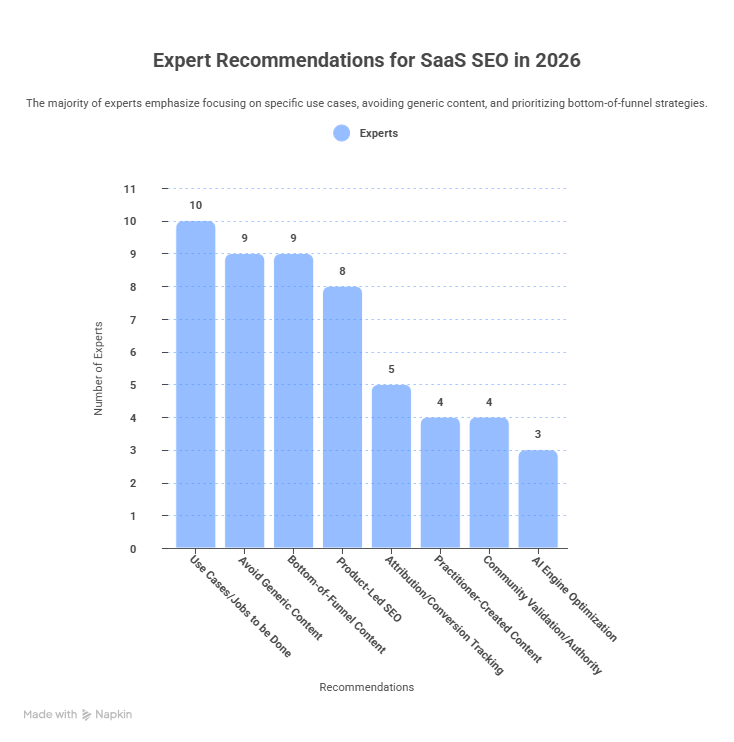
- 10 out of 15 SaaS experts say the key to success is to create content that tackles very specific problems or challenges, rather than just covering generic topics or listing out features.
- 9 in 15 experts echo the warning that volume doesn’t matter – what’s more important is creating content that actually connects with your product, and resonates with the people who are trying to figure out if it’s right for them.
- 9 out of 15 experts also agree that the real focus should be on bottom-of-funnel content – the kind of stuff that only matters when someone is about to make a decision. And by extension, product-qualified lead optimisation is pretty high up on their priority list too.
- 8 in 15 experts reckon product-led SEO or using the resources you already have in product (docs, templates, demos, sandboxes) as the core of your SEO strategy is pretty solid advice.
- 5 of the 15 experts we spoke to say that being able to attribute marketing efforts to real sales and customer journeys is more or less non-negotiable.
- 4 out of 15 experts also argue that content created in collaboration with people who actually ‘get it’ (be that engineers, product folk, customer support or industry insiders) is far more valuable than just marketing fluff.
- 4 of our experts say they’d much rather have a small handful of genuine, high-quality links that validate your brand’s authority, than a bunch of low-grade links that don’t mean much.
- 3 of our 15 experts however did mention game-changing stuff about AI-powered optimisation and search, and how it’s going to change the SaaS SEO landscape for good in 2026.
Get more out of your SaaS SEO with Dandy Marketing
Through both big and small SaaS projects, our research points to a 2026 SaaS SEO future defined by bottom-funnel use cases, highly-targeted content, and connecting SEO to revenue through attribution and product integration. Dandy Marketing specialises in SaaS SEO, delivering audits, content clusters, technical optimisations, and tracking setups that turn organic traffic into a pipeline for B2B tech brands.
Explore our SEO packages or claim your free website SEO audit to benchmark your strategy today.
SaaS SEO Strategy FAQs
How to improve SEO for SaaS companies?
Rather than investing in blogs, focus search engine optimization efforts on bottom-of-funnel content such as comparison pages, alternative pages, pricing information, lists of integrations and use case / role-based landing pages most likely to lead to signups or demos. This approach aligns target keywords with high-converting search intent and improves keyword rankings where it matters most. Then, organize SaaS websites into clusters grouped by jobs-to-be-done or industry-specific use cases.
Make sure in-product doc pages, templates, and onboarding content are indexed and surfaced by search. Use tools like Google Search Console for keyword research and to monitor SEO performance.
And don’t forget that the site still needs to have a strong technical SEO foundation to support SEO (i.e. proper indexing and linking for Google to actually rank the content), alongside traditional SEO best practices, in addition to easy crawling and indexing by AI powered search engines like Algolia so that your site surfaces the highest value content first.
How to create a SEO strategy for a SaaS product?
Kick off by defining product specific goals (e.g. aim to generate more organic PQLs/Trials/Demos) and outline the buyer journey. Identify the target keywords and key questions and tasks that a buyer would be trying to solve for at each stage of the funnel, mapping these to clear search intent—from top of funnel problem discovery through to implementation and expansion.
Based on those insights, determine 3-5 content clusters that emerge from the BOFU content (comparison, alternatives, feature/ integration, role, use case) and are then supported by a layer of mid and top of funnel content. Lastly, develop a plan around how you will technically publish content, measure keyword rankings and overall SEO performance, and tie it all back to business goals (rankings not enough).
How important is SEO in a SaaS business?
With most SaaS companies having some degree of content on their site, search engine optimization is critical in an ecosystem where organic and search driven discovery still accounts for a large portion of the overall customer journey.
Natural search results tend to evoke very high-intent SaaS purchases as users are scouring the web to read reviews of potential vendors, reinforcing the importance of aligning content with search intent. Unlike paid channels which do not compound over time, SEO is critical to driving cost efficient, qualified leads over time and improving long-term SEO performance.
As a SaaS product grows in stature, it cements itself as a clear authority on key use cases and unlocks huge value in the site’s ability to attract high-quality, long-tail traffic at every stage of the SaaS buyer journey, strengthening keyword rankings across both traditional SEO and more advanced technical SEO strategies.
