
How To Check AI Content Quality For SEO


With AI becoming more and more relied on in business content creation, it’s now more important than ever to ensure that the quality of AI-generated content meets both user expectations and SEO requirements.
If you’re diving deeper into this AI-driven world, you may be tempted to trust AI for all your brand content needs, but understanding exactly how to evaluate AI content quality before publishing is (really) vital.
This guide will walk you through the process of AI Content QA (or how to check AI content quality) specifically for business SEO purposes, offering insights into maintaining authenticity, enhancing relevance, and improving readability for your readers and for search engines.
By mastering these elements before you hit publish, you’ll not only engage your audience, but also climb up those search engine rankings.
Ready to refine your content outputs? Let’s get started!
Why AI Content Quality (And Human Input) Matters For SEO
The quality of your Generative AI SEO content matters because it directly affects how real people experience your brand and how search engines evaluate your pages for visibility.
Users: Human‑first, not machine‑first
Users want content that feels written for them by someone who understands their situation, not a generic, auto‑generated article. You may know the feeling by now, but unchecked AI outputs can feel flat, repetitive, or slightly “off”, (hello, AI slop) which quickly erodes trust when published directly to users, and can even make your brand look lazy or inauthentic.
High‑quality, human‑edited AI content still enhances efficiency of outputs by boosting speed, but also shows real experience, nuanced opinions, and practical detail that generic AI can’t reliably produce on its own.
This is what makes users think, “These people actually know what they’re talking about,” which is essential if you want them to remember you, return, or convert.
Search engines: Helpful, trustworthy content
As well as the human readers discovering your content, when you’re creating business content in the hopes of boosting your SEO, you have to consider search algorithms, too. Search engines reward content that is helpful, accurate, and clearly grounded in real expertise, regardless of whether AI was involved in drafting it.
Low‑quality AI pages (thin, generic, unoriginal, or inaccurate) tend to underperform because they fail to fully satisfy search intent and often get outcompeted by richer, more authoritative resources.
Strong human input (from content strategy, through fact‑checking, editing, and adding original insight) is what turns an AI draft into a page that demonstrates experience, expertise, and trustworthiness.
When your AI‑assisted content hits those signals consistently, it is far more likely to rank, attract quality traffic, and support long‑term organic growth.
Why Human Input Is Non‑Negotiable
When ChatGPT first launched, you may have been tempted to churn out AI content for your business website, offering vague ideas to AI tools and publishing without a second thought.
In 2026, and moving forward, this is definitely a bad idea. Human input on business content has to be non-negotiable. And for good reason:
- It corrects inaccuracies and hallucinations that damage credibility.
- It injects brand voice, personality, and POV so content feels distinctly “you.” (or “your brand”)
- It adds real examples, stories, and data that search engines and users both use as trust signals.
- It makes strategic decisions AI can’t: what to cover deeply, what to skip, how to structure for different personas, intent and conversion goals.
How To Detect AI Indicators in Content
Training your team to spot AI indicators ahead of publication is crucial for business content, for all the reasons we have discussed above. Common indicators of AI content might include:
- Overly formal or stiff phrasing: Sentences read like documentation, over-explain basics, and avoid contractions, making the text feel distant and unnatural for most web audiences.
- A flat, neutral tone: The writing sounds “polite but robotic”; rarely uses stories, opinions, or concrete examples, and treats every sentence with the same emotional weight.
- Repetitive structures and transitions: You see the same openings and paragraph patterns repeated across the piece, signaling template-like generation.
- Generic, surface-level insights: The content rehashes what’s already widely known without adding first‑hand experience, data, or specific references to your audience or niche.
- Over-optimised or under-optimised SEO: Some tools over-stuff keywords; others barely integrate them at all or just get them, resulting in either awkward phrasing or missed search opportunities.
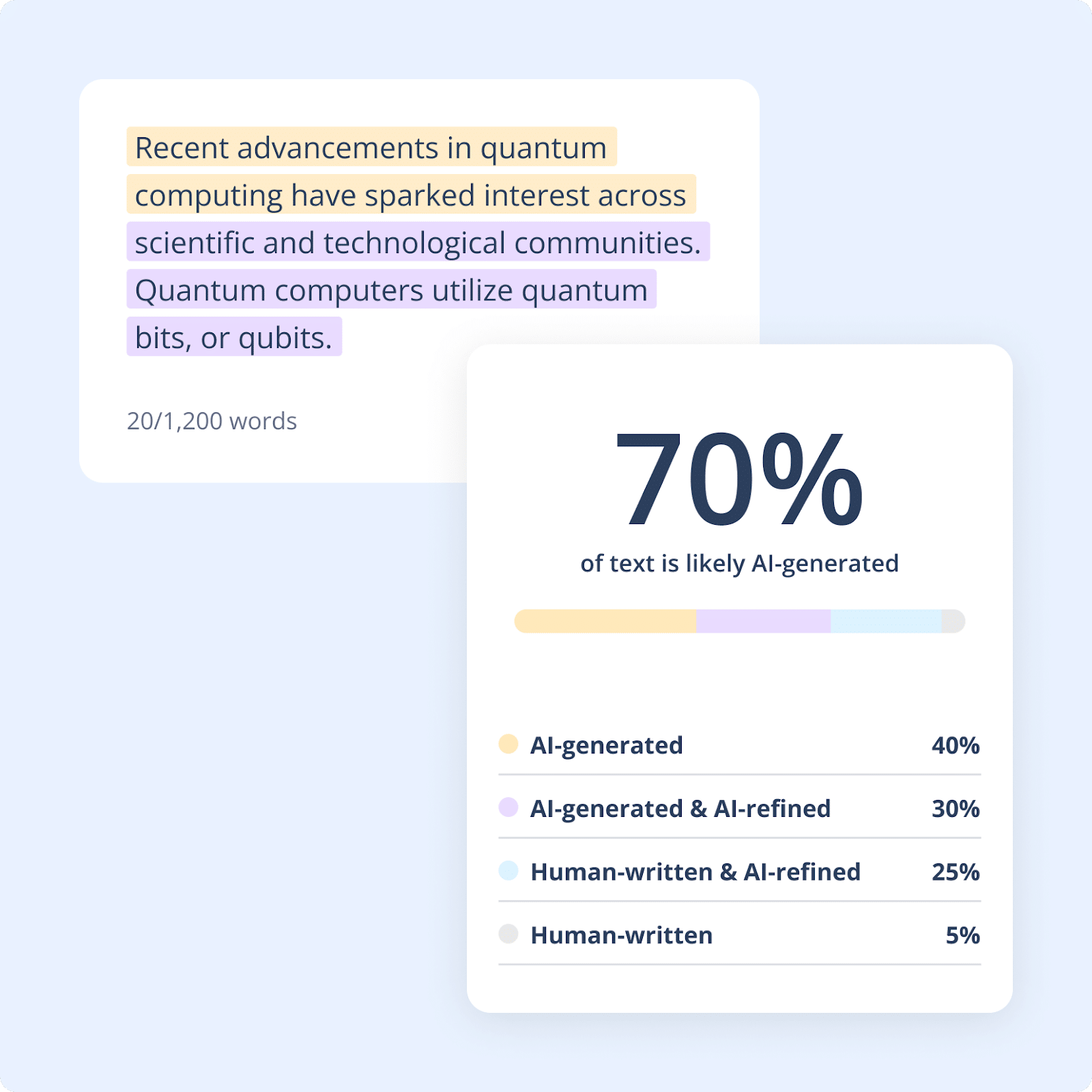
To check AI content for these indicators, you can either manually review, or there are a number of AI detection tools that highlight specific indicators within your content.
You can use these indicators as guidance for manual edits and improvements. Remember, a piece can contain AI-like signals and still be salvageable with strong human editing, added depth, and clearer alignment with both user and business intent.
What To Check For AI Content QA (Quality Assurance)
As well as manually tweaking the key AI indicators to make the content read as more human-led, content quality for SEO also means optimising specifically for search engine performance.
| Checkpoint | What you’re looking for |
| Brand voice match | Tone, vocabulary, perspective aligned to specific business guidelines, not generic AI phrasing. |
| Evidence of real expertise | Specific examples, data, first‑hand insights in the content. |
| Intent and structure alignment | Format fits query type (guide, review, service page, etc.). |
| Readability and flow | Natural language, varied sentence length, scannable layout. |
| Links and CTAs | Helpful internal/external links and clear next steps. |
| Technical SEO basics | Title, meta, headers, schema, media alt text in place. |
| Originality and integrity | No plagiarism, hallucinations, or deceptive automation use. |
You can easily turn this into a one‑page worksheet your team must tick through whenever they use AI models to generate first drafts, ensuring consistent, people‑first high-quality content that aligns with current Google Search rankings guidance. (Or, just download our checklist below. 👇)
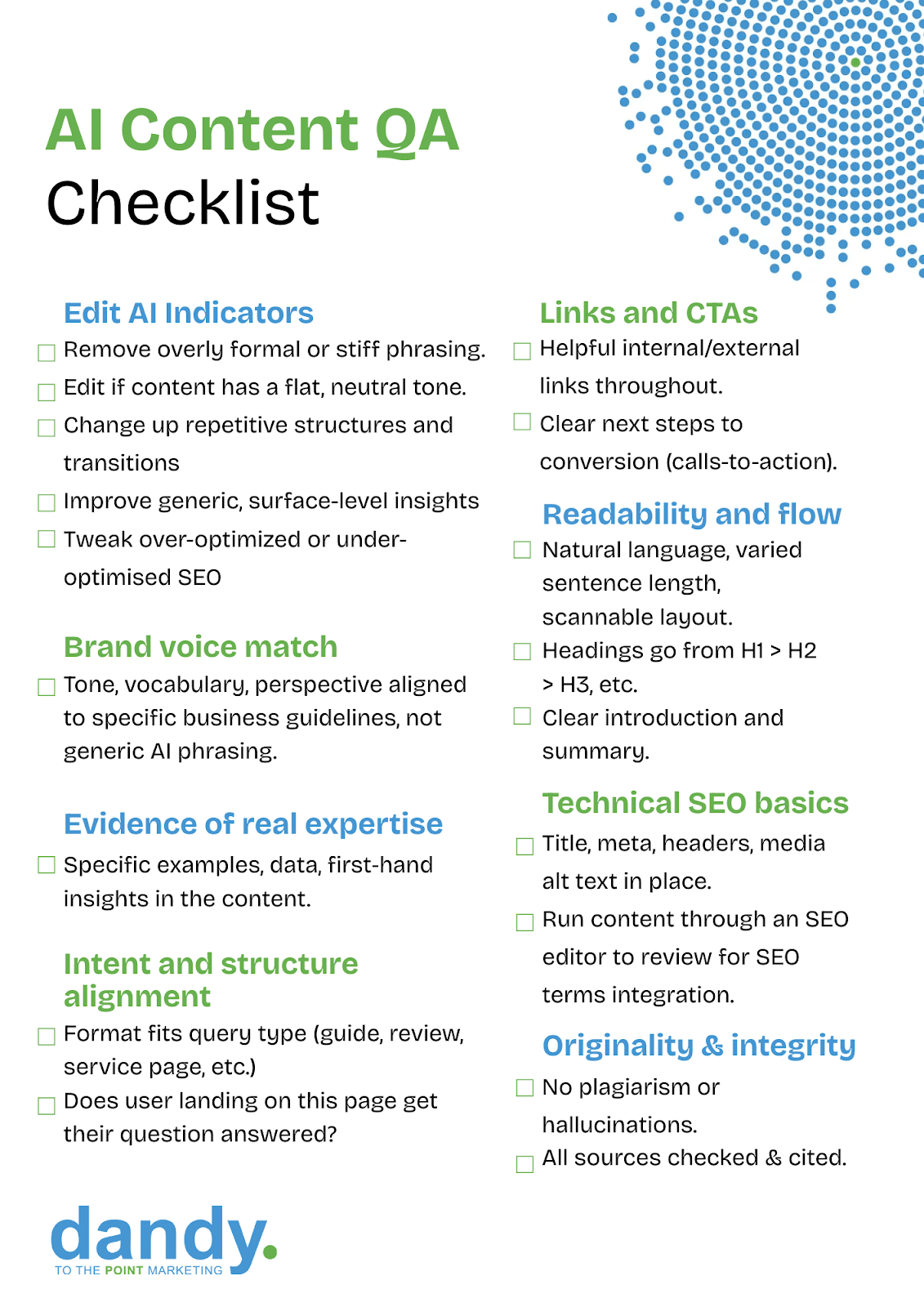
Download your Business AI Content QA PDF here
How To Check AI Content Quality For SEO [Step-By-Step]
1: Brand and voice alignment
- Remember: AI doesn’t necessarily know your brand TOV or style.
- Compare the AI piece against your brand guidelines for tone, vocabulary, and structure, ensuring the content sounds like your specific brand rather than a generic “AI voice.”
- Adjust for audience or persona sophistication (e.g., B2B technical vs consumer-friendly), and ensure point of view (first person, we/you language) is consistent with your usual style.
2: Inject business‑specific expertise
- Generic AI does not have all of your business expertise.
- Make sure to add concrete details about your services, products, processes, and unique frameworks so the article could only belong to your business, not any competitor.
- Check for and add in first‑hand examples, brief case snippets, or lessons learned that directly show your lived experience and reinforce E‑E‑A‑T.
3: Fact‑checking and originality
- Generic AI can be unreliable or outdated.
- Manually verify any data, statistics, or claims against authoritative sources to avoid AI hallucinations and outdated information.
- Run plagiarism checks where stakes are high, confirming that all external facts and references are properly cited.
- Check the sources are original! We have seen AI source data from other AI-generated content,
4: Multi‑media enhancements
- AI draft > publishing without any additional media to engage the user is a big no-go.
- Add supporting visuals such as simple charts, diagrams, screenshots, or custom graphics that clarify key concepts or data instead of just decorating the page.
- Embed relevant videos (e.g., your YouTube explainers, product demos, webinars) and ensure all media have helpful alt text and clear captions for accessibility and SEO.
5: Internal and external linking
- Add internal links to deeper resources (service pages, case studies, etc) that help users progress through their journey and signal topical depth to search engines.
- Include a small number of high‑quality, topical external links to reputable sites to support claims, show research, and build trust.
6: Calls-to-action and conversion flow
- Place clear, button‑style CTAs at natural decision points (after key sections, at the end) with action language tied to the next logical step (e.g., “Book a strategy call”).
- Match CTAs to intent: informational blogs may drive to related resources or email capture, whereas service pages should direct to contact forms or demo booking.
Grab a free SEO audit
7: SEO and technical checks
- Run the content through an SEO content editor to review keyword coverage, semantic terms, and on‑page basics like title tags, meta descriptions, and H‑tag hierarchy.
- Ensure keywords are integrated naturally into headings, intro, and key body sections without stuffing, prioritising readability over rigid density targets.
8: Search intent and content type fit
- Confirm the format of your content matches intent: how‑to posts should prioritise steps and examples; service pages should emphasise your specific offerings, benefits, proof, and objections. You don’t want an article-style piece of content on a page for your product!
- Ask whether a user searching this main keyword would feel their question is fully answered or their task is advanced after reading your piece.
9: Readability, flow, and engagement
- Read the article from start to finish, ideally out loud (or use text‑to‑speech) but at least a quick read through to catch clunky sentences, repetitive phrasing, and abrupt transitions typical of AI drafts.
- Tighten paragraphs, add descriptive subheadings, and use bullets or short sentences where helpful so scanners can extract the main value quickly.
10: Introduction and summary quality
- For blogs, craft a conversational introduction that identifies the audience, acknowledges their problem, and clearly states what the article will help them achieve.
- End with a concise summary or “key takeaways” section that reinforces the main points and naturally leads into the primary CTA, rather than a random section of content.
How To Reduce (Not Replace) Manual Content Edits
The best way to streamline the above process is to add parameters to your AI use in the first place. At Dandy, we have a core “no blind AI” rule; which means all of the tools we use allow for set parameters, and instructions to integrate as much of the above quality guidelines as possible from the get-go, before any content is even generated.
We’ve built SEO and content tools that add context, insight and SEO expertise into their flows, meaning that manual quality assurance processes take half the time.
Remember, this is still not a replacement for human-led work; but you can absolutely streamline these processes by nailing your starting point.
Closing Thoughts
Navigating the world of AI content creation can feel like a daunting task, but it doesn’t have to be. By understanding and maintaining high-quality AI content, you’re not just ticking boxes for SEO success, you’re engaging with your audience in meaningful ways.
At Dandy, we get that the digital landscape is constantly evolving, and we’re here to help you keep up. With in-house developed tools (built with our very own SEO expertise) used as one part of our human-led content workflows, our SEO packages maximise deliverables while retaining quality and originality for both readers and search engines.
Additionally, our GEO services help you get your content generative engine ready, helping you track and improve your reputation and reference potential for users searching via AI search tools.
FAQs
Is using AI mode or generative AI bad for SEO?
Not by itself. Google’s guidance is that content is judged on quality and helpfulness, not whether a real person or an AI mode wrote it. Generative AI is a helpful tool when you use it to create original, people-first content that answers real user questions and demonstrates strong E-E-A-T signals such as clear expertise and reliable sources. Always layer in human editorial oversight to fact-check, add lived experience, and align with your brand so you avoid thin, unoriginal content that could be devalued by core updates targeting low-quality AI pages.
How do I add trust signals to AI-generated content?
Treat your AI draft as a starting point, then enhance it with elements that show there is a real person behind the page. Include author names, concise bios, and clear editorial oversight (for example, “Reviewed by [Role] on [Date]”), which Google associates with higher trust and perceived quality. Cite reliable sources for data and claims, link out to recognised authorities, and be transparent about how content was created and reviewed so users and search engines can see strong trust signals rather than faceless, machine-written copy.
What’s the best way to use Google Gemini or other AI tools in my content workflow?
Use Google Gemini and similar models as a helpful tool for research, outlining, and ideation, then let a subject-matter expert refine the draft for accuracy, tone, and user intent. A good workflow is: generate a draft in AI mode, verify facts against reliable sources, align it with your existing SEO strategy and E-E-A-T goals, and only publish once a real person has applied editorial oversight so the final article delivers genuinely helpful information that can compete in search.

25 Effective Content Strategy Insights & Trends For 2025
August 2, 2025
Why You Need a Content Strategy
October 18, 2024
How To Write B2B Content That Converts
August 16, 2024