

Small businesses put enormous effort into being found. Keyword research, landing pages, ad budgets, endless tweaks to page titles. Then someone fills in the contact form on a Tuesday evening and hears nothing until Thursday afternoon.
That gap is where marketing budgets quietly leak.
Most Businesses Take Two Days to Answer an Enquiry
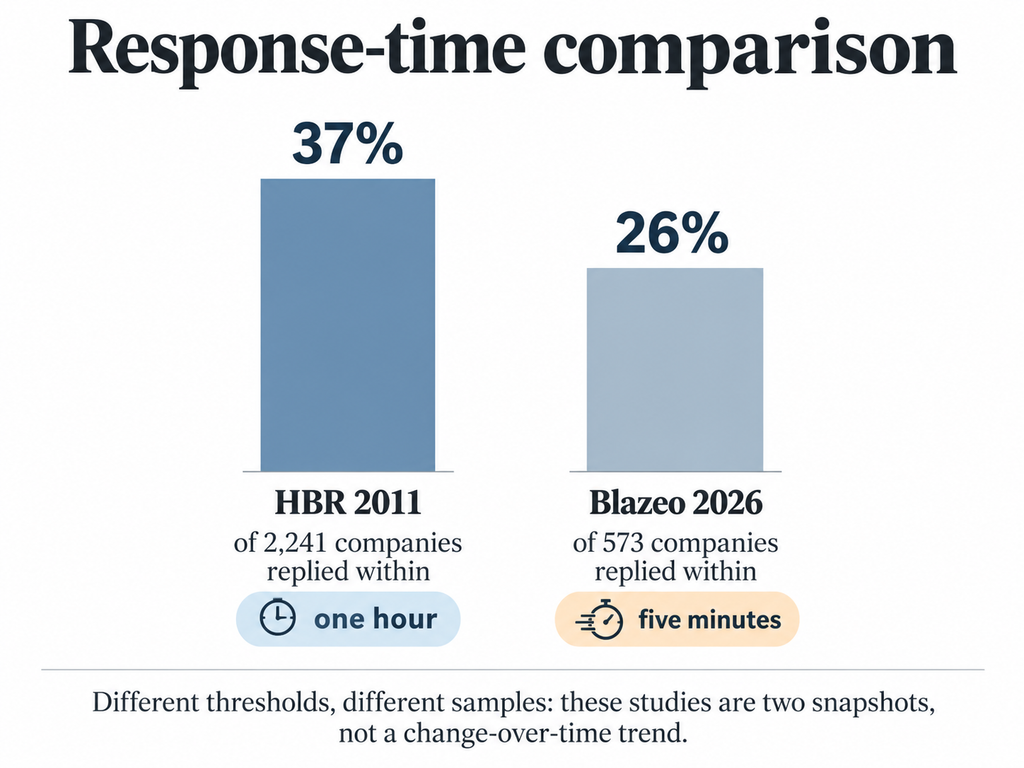
The research on this is uncomfortable reading. A study published in Harvard Business Review audited 2,241 companies by sending each one a test enquiry through its own website and timing the reply. Only 37% responded within an hour. Nearly a quarter never responded at all, and among the companies that did reply, the average wait was 42 hours. Two days is a long time to leave someone hanging when they contacted you precisely because they wanted an answer.
That study is from March 2011. James Oldroyd, Kristina McElheran and David Elkington ran it when plenty of businesses still treated a web form as a novelty, which invites the obvious objection: everyone has a CRM now, so surely somebody has fixed this.
Blazeo checked in February 2026, across 573 US service companies. 74% missed the five-minute window. And of the leaders who told Blazeo that a five-minute reply was essential to their business, only 62% actually managed one. They know it matters, they have bought the software, and it still does not happen.
Why an Enquiry Goes Cold So Quickly
Enquiries have a short shelf life. Someone looking for an accountant, a piece of software or a kitchen fitter rarely contacts a single company. They open four tabs, send four messages, and the work usually goes to whoever answers first. The same study found that firms responding within an hour were almost seven times more likely to qualify a lead than slower responders, and sixty times more likely than those that took a day or longer.
Speed, in other words, is a conversion factor. Probably a bigger one than most of the things businesses spend their time on split testing.
So a business replying second is not really being judged on price, or on the quality of its work, or on any of the arguments its website spent months getting right. It is being judged on whether it picked up.
Enquiries Do Not Keep Office Hours
The awkward part is that enquiries do not keep office hours. Figures from the ONS show online purchases made up 28.7% of British retail sales in March 2026, and the browsing that leads to those purchases happens after work, on the sofa, late on a Sunday night. Service businesses see the same pattern in their form submissions. A company that only answers between nine and five is effectively closed during a big slice of its own demand.
Nine to five on weekdays comes to 40 hours out of 168. Everything that arrives in the other 128 was still paid for, whether it came in through organic search or through an ad someone paid to put in front of them.
Where Chatbots Earn Their Place
This is where chatbots have gone from gimmick to genuinely practical. A well set up bot answers routine questions instantly at any hour, captures a name and an email address when a query needs a person, and drops the complicated conversations into the morning queue with context already attached. The visitor gets an immediate response instead of a void. The business wakes up to warm leads rather than cold form fills that went stale overnight.
The Four Jobs a Bot Has to Do
Demos all look good, so a feature list is a poor way to choose one, and the better question is what the thing actually has to get through on a Tuesday evening with nobody watching.
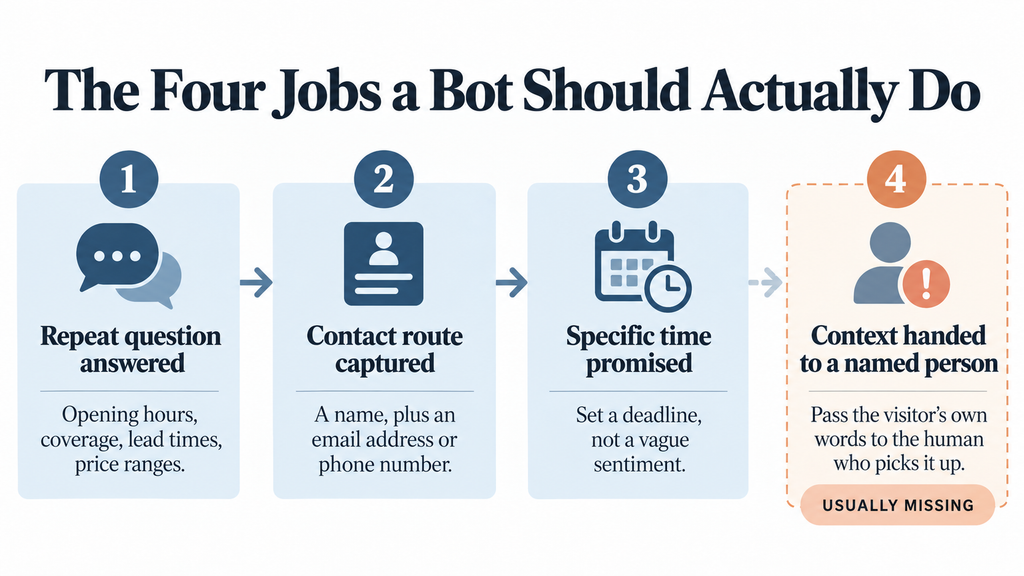
- The questions that repeat. Opening hours, coverage, lead times, price ranges. If a person answers something the same way every time, a bot can answer it.
- A name, and either an email address or a phone number, before the conversation ends.
- A time. Not “someone will be in touch”, but by ten tomorrow, or within the hour.
- The question passed on in the visitor’s own words, to whoever picks it up.
Most setups manage the first three. The fourth is the one that gets skipped, which leaves a contact form with a personality and somebody starting the conversation over.
Where a Bot Is the Wrong Fix
Some businesses should not bother, and no salesperson is going to be the one to tell them.
A company taking two or three enquiries a week will spend longer configuring a bot than it ever saves. Answer them yourself, faster.
Regulated or genuinely bespoke advice is the harder case. A bot that attempts an answer creates a liability, and one that deflects everything irritates people more than having no bot at all, so the only safe version books a call and says nothing else. Some firms are happy with that. Most decide it is not worth the licence fee.
More often, though, enquiries are going cold because nobody is checking the inbox. Adding a bot fills that inbox faster and changes nothing else. Work out who is on the inbox first.
A Friendly Bot Beats a Clever One
Whether it works depends heavily on the tool. Most people have met at least one infuriating bot, and patience for bad automation is thin. Zendesk’s guide to the best AI chatbots notes that 64% of consumers are more inclined to trust and engage with AI agents that come across as friendly and even a little human. Tone is not cosmetic. A bot that greets people naturally, admits what it cannot do and hands over to a person without friction will outperform a more sophisticated one that traps users in a loop.
The Handover Is the Whole Job
That handover point deserves real attention. The job of a chatbot in a small business is not to replace anyone. It is to hold the door open until a human is available: acknowledge the enquiry, gather the details, set an expectation. Customers are surprisingly forgiving of waiting when they know someone has their request and roughly when they will hear back. What they do not forgive is silence.
In practice that is four lines in an email or a CRM note. What the visitor asked, in their own words and not flattened into a category. How to reach them, when they got in touch, and what the bot has already promised them.
The last one gets left out constantly, which is how you end up ringing someone back with no idea what they were told.
Customer Expectations Keep Moving
Expectations keep rising too. The July 2026 edition of the UKCSI, the national customer satisfaction index, put UK satisfaction at 78.3 out of 100, up a point on the previous year, and found that being easy to deal with now matters more to customers than it did six months earlier. As the average experience improves, slow responders stand out for the wrong reasons. Small firms used to get away with “we’re a small team” as an explanation. Increasingly, customers compare every business to the best one they dealt with that week.
How to Set One Up Without Overthinking It
For a small team wondering where to start, the boring approach works best. Pull the last hundred emails or calls and list the ten questions that come up constantly: opening hours, pricing, lead times, returns, coverage areas. Those ten answers are the first version of your bot. Connect it to the same inbox or CRM your team already uses so nothing lands in a separate system nobody checks. Then read the transcripts once a month. They will tell you what customers actually ask, which is rarely what the website assumes they ask, and that insight alone tends to pay for the exercise.
Write Down a Target Before You Buy Anything
Lead response time is the gap between an enquiry landing and a reply going out. One number from the Blazeo audit is worth acting on straight away. Companies with a written response target hit a fifteen-minute reply 54.9% of the time. Without one, 29.5%. Same industries, same tools available to both. The only difference is that somebody wrote the number down.
So write the number down. Fifteen minutes in working hours, first thing next morning for anything that came in overnight, and a name against each day of the week, because a target nobody owns is just a preference.
Buy a tool after that, if you still need one. Plenty of teams find they do not.
What to Check After the First Month
Four numbers, and none of them need a dashboard.
Median lead response time is the headline. Then the share of conversations the bot handed to a person, the share of enquiries that arrived outside opening hours, and the list of questions it could not answer. That last list is next month’s work.
The handover share is the one to read carefully. Above roughly half and the bot is answering too little to earn its licence, while anything near zero usually means it is guessing rather than deferring, so go through a dozen transcripts by hand before anyone congratulates themselves.
Frequently Asked Questions
How quickly should you respond to an online enquiry?
Five minutes during working hours. First thing next morning for anything that lands overnight. Blazeo’s February 2026 audit of 573 US service companies found 74% miss the five-minute mark, so this is still somewhere to get ahead rather than a box to tick.
Can a chatbot replace a receptionist or a sales team?
No. Setting one up on that basis is how businesses end up with the kind of bot everyone complains about. It covers the gap between an enquiry arriving and a person reading it, and then it gets out of the way.
What should a chatbot do when it cannot answer a question?
Admit it, take a name and a way to reply, and give a specific time. Then pass the question on as it was actually asked. A bot that says it does not know and hands over will beat a cleverer one that keeps guessing.
Do chatbots put customers off?
Bad ones do. What people object to is being trapped, not being greeted. A bot that opens naturally and hands over when asked tends to go down fine. The ones that offer you the same three options whatever you type are why the category has the reputation it does.
How many questions does a chatbot need before it is useful?
Ten. Pull the last hundred emails or calls, find the ones that keep repeating, and write those answers properly. Do not rush to widen it after that, because one confidently wrong answer will undo several correct ones.
Protect the Marketing You Have Already Paid For
None of this reduces the value of the marketing itself. It protects it. Every inquiry that goes cold overnight is money already spent on a click, a visit and a form fill, written off at the final step. Fixing response speed is usually cheaper than buying more traffic, and the businesses that treat the first five minutes after an inquiry as seriously as the campaign that produced it tend to convert better than their ad budgets would suggest.
It does not need a new campaign either. Just an afternoon with the inbox and the form submissions open side by side, working out where things currently go cold. For a small team that is usually a better use of a day than anything else on the marketing plan. If the afternoon keeps not happening, Dandy can take a look.
Marketing gets them in the door. What happens in the next few minutes decides whether they stay.
Author’s Bio: I’m Harsh Founder of SaaSit.in dedicated to helping SaaS and tech companies drive organic growth through strategic link building and data-driven outreach.
Email ID: harsh@saasit.in