
How To Boost Your Visibility in AI Search Results

So you want to make a splash in the world of AI search results? With search engines constantly evolving thanks to artificial intelligence, just throwing a few keywords into the mix isn’t going to cut it anymore. AI has quite literally flipped the script, introducing conversational search experiences & brand new forms of AI-generated content.
Not sure where to start? Don’t worry about it, we’ve got you covered. We’re about to dive into how you can make your content stand out across all platforms, AI and traditional.
GEO (AI Search) Services That Get Results
What “AI Visibility” Actually Means
Improving AI visibility = increasing the likelihood that your content is:
- Selected as a source
- Summarised in AI answers
- Referenced as a trusted brand
This is driven by a mix of:
- Topical authority
- Content structure (retrievability)
- Entity signals (brand + trust)
- Off-site mentions
It’s not just about keywords anymore—it’s about being understood and selected.
Digital marketing strategies for a new era of search
Getting a handle on the difference between old traditional search engines and the new AI-powered ones is key to any SEO approach now. Google, for example, has been experimenting with AI-powered summaries of search results for a while, in a bid to make search more engaging and intuitive for users.
Then there’s Google AI-mode – which essentially adapts search intents and queries using in-depth algorithms to deliver contextually relevant results in a lovely conversational style experience. It’s not dissimilar to what you’d get from Google’s own take on a ChatGPT-style experience. And then you’ve got full-on AI search engines like ChatGPT, Gemini & Claude, that play a whole different ball game.
These AI tools rely on large language models (LLMs) to engage users in conversational search experiences and provide AI-generated, back-and-forth conversations that go far beyond just showing you blue links.
Here’s a quick rundown to help you wrap your head around these AI search engines:
| Attribute | Google AI-mode | ChatGPT / Gemini |
| Interaction | Mainly web-based | Conversational |
| Functionality | Synthesis with classic search | Standalone AI responses |
| Data Usage | Indexed web data | Pre-trained datasets and web data |
| Personalisation | Limited, but improving | Dynamic and extensive |
| Result Presentation | Integrated | Separate AI results |
AI Overviews
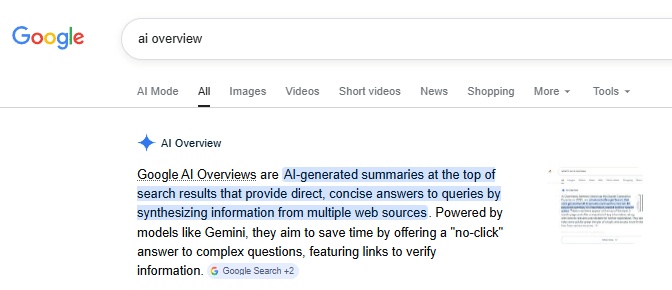
AI overview from Google SERP (Results page)
Google AI overviews within search results do a brilliant job of synthesising information quickly, providing users with concise answers right at the top of the results page. They pull in data from multiple web sources across Google Web and present a user-friendly digest of information.
AI-Mode
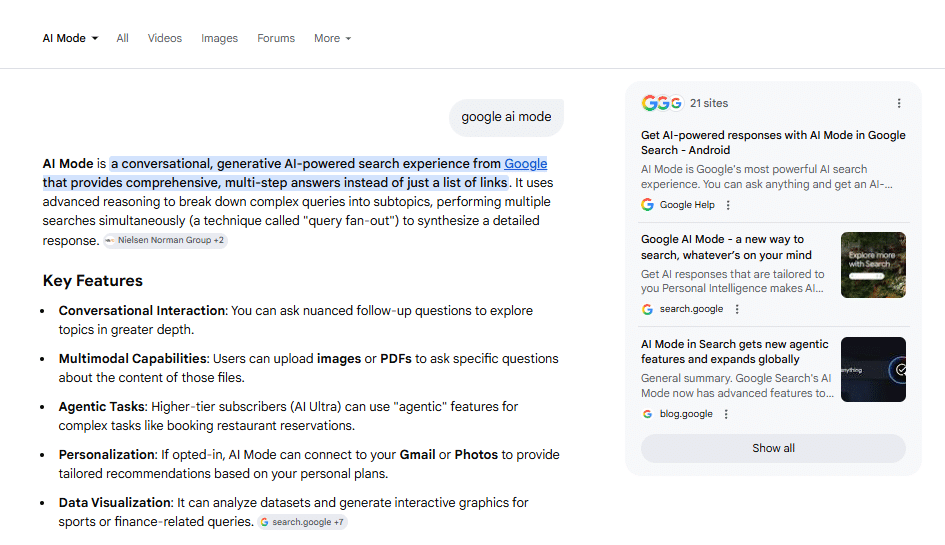
AI -mode search snapshot
Google’s AI-mode is pushing the boundaries by focusing on search intent and employing complex algorithms to adaptively interpret and respond to queries.
This feature dynamically refines the search experience to present content that’s most relevant to the user’s needs, which is a real game-changer for AI ranking factors.
AI Engines (ChatGPT, Gemini, Claude, etc)
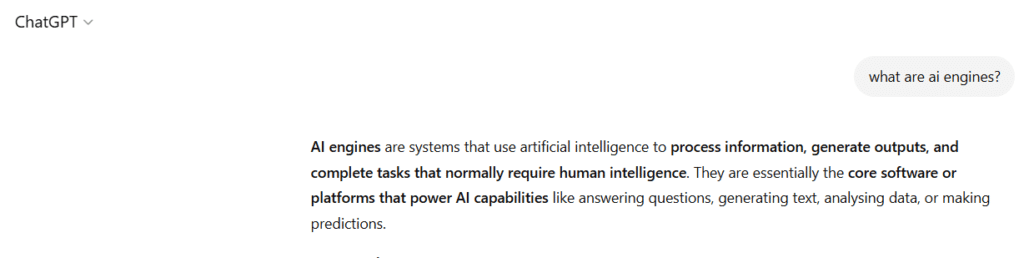
ChatGPT search chatbot snapshot
AI engines like ChatGPT and Gemini engage users in dialogue, offering AI-generated responses that feel bespoke and consultative.
These engines don’t rely on traditional search engine algorithms but instead use machine learning techniques to generate responses based on ever-growing datasets.
Understanding AI ranking factors can help you create content that really resonates with these engines.
AI Search Optimization: Techniques to get referenced by AI search engines
Getting visibility in this new landscape requires some targeted strategies that can handle both AI and traditional web searches.
First off, define the core topics of your content and group them into meaningful chunks. Next, get stuck into some extensive keyword research to flesh out each topic comprehensively.
AI doesn’t favour isolated pages—it favours topic ownership.
Instead of:
- One article on “ecommerce SEO”
You need:
- A cluster covering:
- product page SEO
- category optimisation
- technical SEO for ecommerce
- internal linking
- CRO
Interlink them tightly and reinforce a single entity.
This increases your chances of being selected as a trusted source.
Here are some key techniques:
Review if AI can access & digest your website content.
Most AI search systems (ChatGPT/GPTBot, Perplexity, Claude, etc.) behave more like lightweight, resource‑sensitive crawlers than Google’s evergreen Chrome. They often:
- Fetch the raw HTML
- May not fully execute JavaScript (or do so with strict resource/time limits)
- Prefer pages that respond quickly and render key content in the initial HTML
Implications:
- Anything that only exists after client‑side rendering (SPA content, JS‑injected copy, links, schema) is at risk of being partially or completely invisible to AI crawlers.
- Slow backends (high TTFB) can cause crawlers to abandon or de‑prioritise pages, leading to incomplete indexing and lower inclusion in AI answers.
TTFB: why it matters for AI + SEO
TTFB is essentially the “gatekeeper” metric that decides how quickly crawlers and users can start seeing your content. It doesn’t change the quality of what you’ve written, but it strongly influences whether search engines and AI systems can access and process it efficiently.
For AI in particular, slow TTFB forces crawlers and real‑time fetchers (e.g. AI Overviews, Perplexity, ChatGPT browsing) to wait before they can even start parsing HTML. If that wait is too long, they may crawl fewer URLs, abandon mid‑page, or skip your content in favour of faster sources—all of which reduce your chances of being indexed, refreshed, and cited in AI answers.
Because TTFB sits at the very start of the performance chain, it also pushes back First Contentful Paint and Largest Contentful Paint, which hurts Core Web Vitals, user experience, and engagement signals. That doesn’t just matter for classic SEO; models feeding AI systems increasingly rely on these performance and behaviour metrics as proxies for quality and reliability. In practice, teams that bring TTFB under roughly 200 ms see faster crawling, more consistent indexing, and significantly higher visibility in AI‑generated content.
Key points:
- TTFB measures the delay from request to the first byte of HTML; it’s purely about server + network responsiveness, not full page load.
- High TTFB slows down crawlers, reduces crawl efficiency, and can cause deeper pages or frequently updated content to be discovered and refreshed later.
- AI crawlers and real‑time fetchers operate under tight latency budgets; slow TTFB increases the chance your content is skipped or only partially processed.
- TTFB directly affects FCP/LCP, which in turn influence both SEO and AI visibility via page experience and engagement signals.
- Studies and case studies show that reducing TTFB (e.g. from 800 ms+ down to <200 ms) improves crawl rates, recrawl frequency, and AI citation rates, sometimes by 40–60% or more.
While TTFB isn’t a direct ranking factor, it effectively sets a ceiling on how far your content, technical SEO, and AI visibility gains can go; great content with poor TTFB may never be fully leveraged.
Semantic chunking for AI optimisation
- Using semantic structure creates organised content chunks that are easier for AI technologies and search algorithms to navigate. By clustering related ideas and themes together, you can bulk up each piece of content’s relevance.
- Imagine a digital marketing agency detailing its services. Instead of listing them all randomly, the agency can categorise offerings by function or benefit, making it way easier for AI engines to get their heads around.
Have a read of this article on Semantic SEO
Query fan-outs & selective prompt-tracking
- Query fan-outs involve expanding primary search terms with related queries, broadening topic coverage and thereby improving AI relevance and content optimisation.
- Refine with prompt-tracking to monitor AI responses to further optimise search performance. By analysing prompts you can fine-tune your content and boost its visibility in AI search results.
Structured data for optimal AI results
- Using structured data like tables & marked-up diagrams provides AI engines with clear information hierarchies, enhancing understanding and delivery of relevant search results.
- An ecommerce site, for example, can include tables summarising product features, prices & availability. This structured presentation helps AI snippets and summaries read and then reflect the business offerings more accurately.
Own Third-party mentions
AI doesn’t trust your website alone. It looks for as many sources as it needs to form a reliable consensus that it will feed back within its prompts. Whilst it may take some of this from your own website, it massively looks for third party proof.
So some keyactions to take:
- Invest in digital PR. This could range from data led campaigns to thought leadership pieces and getting featured in round ups.
- Get featured in niche-relevant publications
- Build topical authority beyond your own domain
AI Optimisation Example
As an example, let’s look at a very simple prompt “best project management software for small business”. You can see it brings back recommendations, and that being at the top of this list, or at least being included, would be very important and beneficial for project management tools.
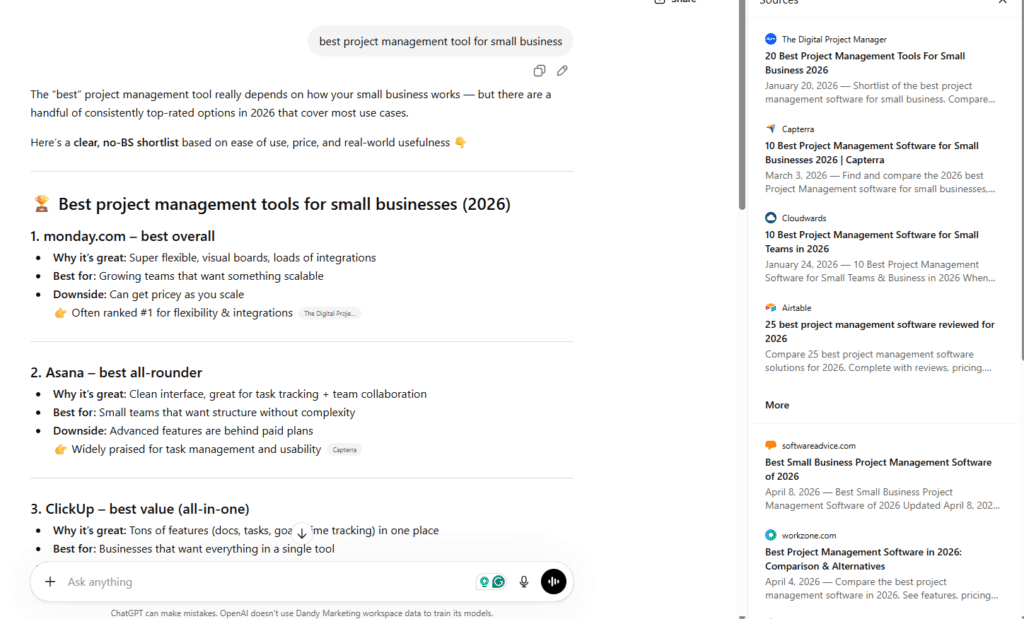
The top 3 are some very well know brands, we use Asana at Dandy, so these are the brands I would probably have expected to see. But why are they there?
If you scroll down to the end of the prompt you’ll see “sources”, clicking that opens up the right-hand column. These are the sources that are influencing ChatGTPs response. If you wanted to be in the conversation and improve your chances of being recommended, you’ll have to be in some of those lists.
Some are easier than others, for example you could create a listing on Capterra, start collecting reviews etc. The others you’ll have to reach out to and try and get included.
If we look at the query fan outs for this keyword using the Chrome Extension, ChatGPT Search & fan-out capture by RESONEO we can see the below.
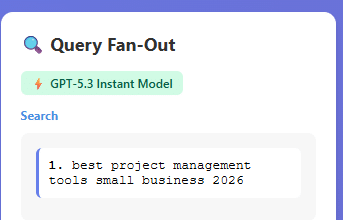
All those sources rank for this keyword, so it would be very hard to knock them off. Your best bet would try to be included in those lists. This goes back to the “own third party mentions” point.
But the other things to consider are:
- Those three brands all have massive content strategies ranking for relevant clusters
- They are have strong reviews across multiple platforms
- They are all included in influential sources
- They have strong brand positioning and on site content.
Innovation in AI: Dandy Marketing’s role in your AI search strategy
At Dandy Marketing, we’re bringing SEO services and AI together in a big way – with a focus on innovative ideas that puts SEO first, and making the most of the latest AI breakthroughs. We’re even developing our own ultimate SEO tool.
What sets us apart is that every single client gets a bespoke approach, because we understand that no two businesses are exactly alike. That means we can help you get the most out of your AI search visibility.
By working closely with you, Dandy Marketing becomes an extension of your team – and that means we can move fast and adapt quickly to the rapidly changing world of AI search.
We don’t lock you into long contracts, so you can rest assured that we’re always pushing to make things better. And with our flexible approach, we can keep on top of all the latest algorithm updates, even the AI-based ones.
Want to see how we can give your online presence a boost? Take a look at our GEO (AI Search) Services to learn more.
The bottom line and what you need to know
For AI-powered search engines, staying on top takes a combination of old-fashioned know-how and cutting-edge tech. Here are the key takeaways:
- Get Your Head Around the Different Types of AI Search Engines: Google combines AI insights with plain old search results, whereas engines like ChatGPT are total conversation machines .
- Make server‑rendered, fast HTML one of your core GEO pillars.
- Making Sense of SEO with Semantic Optimisation and Quality Content: Think of your content as a load of jumbled up bits – group it into useful chunks and structure it in a way that makes sense to AI. That way your key points will start to stand out and your content quality will improve.
- Improve Your Online Reach with Query Expansion: Bigger is better when it comes to targeting – expand the topics you’re covering with a wider range of related searches, and keep an eye on how the AI is responding so you can tweak things for even better results.
- Get the Most out of Structured Data: Using clear tables and marked-up diagrams makes it a whole lot easier for AI to serve up search results that are spot on – with all the bells and whistles you see in search engine results pages.
You need to give your online presence a bit of a kick, and with these strategies you’re already getting there – just remember, SEO is a constantly shifting landscape, so keep working at it and you’ll be in good shape.
Dandy Marketing is here to help you navigate all the twists and turns – stick with us and you’ll be sailing forward in no time. Before you know it you’ll be out in front!
Grab a free SEO health check
