
These SEO statistics tell a clear story: the way people find, research and buy from businesses has fundamentally changed. Whether you run a local business or manage an ecommerce site with thousands of products, the data below should shape how you invest your time and budget in 2026.
We originally published this post back in 2019 with five stats that mattered. Seven years on, we have updated those stats with the latest data and added several new sections covering everything from Google’s AI Overviews to voice search optimization, technical SEO, and the growing role of artificial intelligence in how search engines rank and display content.
Let’s get into it.
1. 76% OF CONSUMERS WHO DO A LOCAL SEARCH VISIT A STORE WITHIN 24 HOURS
Local search has only grown more dominant since we first published this post. Today, 76% of people who search for something nearby on their smartphone visit a business within a day — and 28% of those searches result in a purchase.
Even more striking, 88% of consumers who conduct a local search on their smartphone visit or call a store within a week.
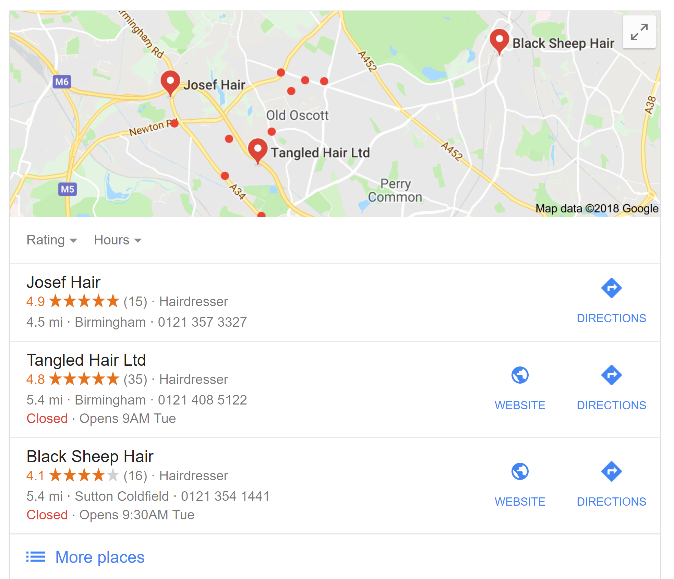
The good news about this is that is completely free, this map pack appear in around 93% of local search results so you can see the importance of having this set up.
Local SEO continues to grow in importance. According to Rio SEO’s 2025 Local Search Consumer Behavior Study, 84% of consumers now search for local businesses online daily, and 75% read at least four reviews before making a decision. Meanwhile, 46% of all Google searches have local intent — that’s nearly half of everything searched on Google.
- If you wish to drive instant traffic to your
website, or footfall consider PPC advertising with radius targeting, add
location and call extensions to these as well. - If you have local store pages ensure these have Local
Schema Mark up correctly implemented on them. - Depending on your industry you could look at
Yelp, TripAdvisor etc. Your customers will look to other websites apart from
Google to get a good idea of your business and products.
2. 58% OF CONSUMERS NOW DISCOVER NEW BUSINESSES ON SOCIAL MEDIA AND MOBILE SEARCH
Mobile has moved well beyond “important” — it’s now the default. As of mid-2025, mobile accounts for 62–64% of all global web traffic, and Google fully completed its mobile-first indexing rollout in July 2024. This means Google now uses the mobile version of every website for indexing and ranking — no exceptions.
The commercial impact is massive. US mobile commerce sales are projected to reach $710 billion in 2026, making up roughly 47% of all US retail e-commerce. Globally, mobile commerce accounts for 59% of all online retail sales and drives 78% of all e-commerce traffic.
Meanwhile, 58% of consumers report discovering new businesses via social media, outperforming traditional search and even TV for brand discovery. Mobile apps convert at 3.5% versus just 2% on mobile web, and reduce cart abandonment from 97% to just 20%.
What you need to do right now:
Check if Google views your website as mobile friendly — you can do this in Google Search Console under Settings > Indexing Status.
Ensure your website is fast to load — https://developers.google.com/speed/pagespeed/insights/
Google’s September 2025 core update reinforced mobile performance as a stronger ranking factor, so sites with poor mobile metrics can see significant ranking drops. If your site isn’t performing well on mobile, treat it as a priority.
3. 67% OF B2B BUYERS CONSUME AT LEAST 5 PIECES OF CONTENT BEFORE ENGAGING WITH A SALES REP
The phrase “content is king” hasn’t gone away — if anything, it’s more relevant in 2026 than ever. According to SQ Magazine, 67% of B2B buyers now consume at least 5 pieces of content before they’ll even speak to a sales rep. In more complex B2B purchases, the average buyer interacts with 13 pieces of content before making a decision.
The growth of social media and mobile phone usage have seen our eyeballs consume a tremendous amount of content, be it videos, snapchats, ebooks, podcasts whatever it may be the amount of content out there is mind-blowing.
Because of this mind-blowing amount of content, to put it simply, there is a lot of sh*t content out there and you need a way to cut through this and provide true value. If you don’t have a content strategy, its not going to work.
What you need to do:
- Find out and answer customers problems – use tools like AnswerThePublic to find questions that are searched related to a particular topic. Finds questions on Quora and top threads on Reddit to give you inspiration.
- Find out what’s being shared and talked about on Social – you can use tools like BuzzSumo to see the most shared content around a particular topic.
- Showcase how your business or product solves customer problems – case studies are a great way to do this but need to be engaging. Video testimonials could be another way to do this.
4. 92% OF MARKETERS SAY SOCIAL MEDIA HAS INCREASED THEIR BUSINESS EXPOSURE
Social media marketing isn’t optional anymore — it’s a primary business channel. According to Synup, 92% of marketers say their social media efforts have increased exposure for their businesses, and 93% report that social media has increased business traffic.
The numbers are staggering. There are now 5.66 billion social media users worldwide — that’s 69% of the global population. Facebook remains the largest platform with 3.22 billion monthly active users, followed by YouTube (2.85 billion), Instagram (2.2 billion), and TikTok (1.7 billion). The average person spends 2 hours and 21 minutes per day on social media and uses around 6.7 different platforms each month.
Your customers and potential customers are most likely to have a mobile phone and social media profiles they check -10 times a day without even thinking about it.
The targeting options you have within these social channels is quite scary, so you can be sure you will be able to get in front of a relevant audience if you want to pay for it.
There are many brand that have grown their business through social media, Gymshark is one example of this. Using social media influencers such as Lex Griffen and Steve Cook they successfully got in front of their target market in a non-intrusive way and now they are one of the fastest growing companies in the UK with a growing world-wide brand reputation.
What you need to do:
- Find influencers who match your brand vision and values to promote your business or products. Famebit is a great way to do this.
- Truly invest in social media, don’t treat it as an after though, create social media strategy that is integrated into your overall digital marketing strategy.
- Consider using a social media management tool such as Sprout Social or Hootsuite.
- Use social remarketing to target website visitors. Software such as AdRoll make this extremely easy, or you can do this via Facebook itself and implement its Pixel
5. THE AVERAGE CONSUMER NOW ENGAGES WITH 56 TOUCHPOINTS BEFORE MAKING A PURCHASE
The customer journey has become far more complex than it was just a few years ago. Today, the average consumer engages with a brand across 56 touchpoints before buying. Google’s own research found that the average consumer journey now involves anywhere between 20 and 500+ touchpoints, depending on the industry and purchase value.
For major purchases, the average decision-making period is 79 days. In B2B, the typical buying cycle lasts around 10.1 months and involves 10–11 stakeholders. Even for everyday essentials, 52% of consumers review two to three channels before buying.
The chart below details the customer journey and how digital channels can ensure that you stay in front of mind and in a positive way.
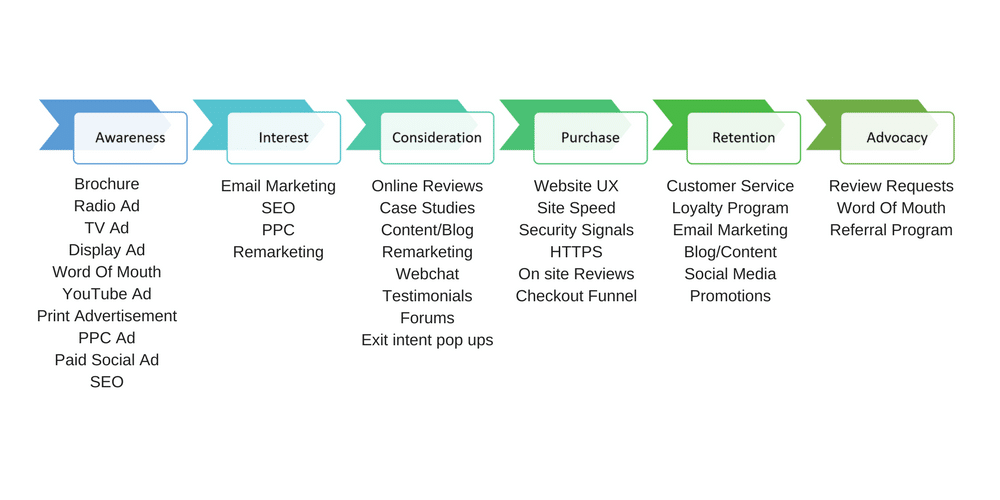
A full digital strategy will work in holistic harmony and ensure a positive brand image whilst your potential customers goes through all the necessary steps they need to in order to feel comfortable enough to purchase from your brand.
6. GOOGLE’S AI OVERVIEWS ARE CHANGING HOW PEOPLE USE SEARCH RESULTS
This is the biggest shift in search since mobile-first indexing, and most marketers have not caught up yet.
Google’s AI Overviews now appear on roughly 48% of all tracked search queries, up 58% year over year. These AI generated answers sit at the top of Google SERPs, above the organic search results that most SEO efforts have always targeted. When an AI Overview is present, organic click-through rate drops by around 61%. 58% of Google searches now result in zero clicks, meaning over half of internet users get their answer without visiting a website.
But here is the other side. Brands cited within AI Overviews earn 35% more organic clicks and 91% more paid clicks compared to those not cited. Pages ranking in the top 10 have a 33% chance of appearing as an AI source, and AI search visitors convert at 23 times the rate of traditional organic traffic. So your Google rankings still matter, they just feed into a new layer of AI visibility too.
What you need to do:
Focus on becoming a citable source. Produce original data and research that AI models will want to reference. Build your brand presence across the web, not just on your own site. Over 73% of brands have zero mentions in AI generated answers despite ranking on page one, because AI bots pull from publishers, user generated content, and review platforms as much as your own domain. Think of AI citations as a layer on top of your existing SEO efforts, not a replacement for them.
7. VOICE SEARCH IS NOW A MAINSTREAM MARKETING CHANNEL
Voice search is no longer a novelty. It is a daily habit for millions.
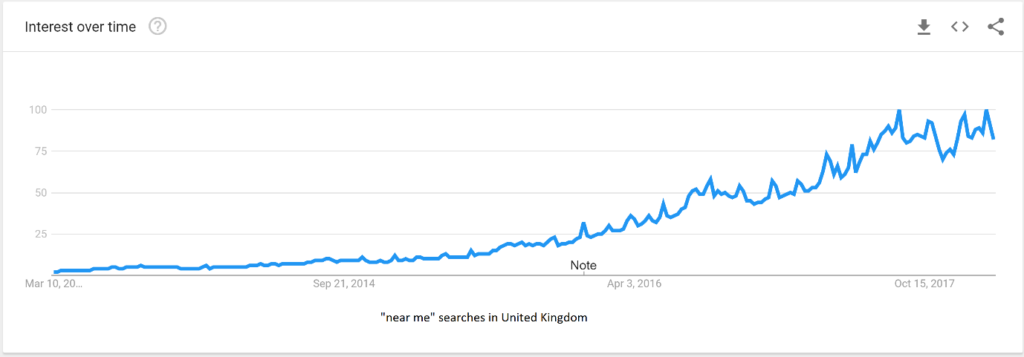
There are now an estimated 8.4 billion voice assistants in use worldwide, more than the global population, because most people have multiple voice-enabled devices. 58% of consumers have used voice search to find local business information, and “near me” queries make up 76% of all voice searches. Voice search optimisation is especially important for local businesses, since voice queries are three times more likely to be local in nature than typed searches.
What you need to do:
Structure your content around natural, conversational language. Voice search queries average around 29 words and use long tail keywords that sound like how people actually talk. Think “what is the best Italian restaurant near me that is open now” rather than “Italian restaurant London.”
Implement FAQ schema and structured data on your site. 40% of voice search results come from featured snippets, so a question-and-answer format helps search engines pull your content for voice queries.
Optimise your Google Business Profile for voice search optimisation. Keep your hours, location, phone number, and services complete and accurate. Voice assistants and smart speakers rely heavily on this information when answering local searches.
8. TECHNICAL SEO IS THE FOUNDATION EVERYTHING ELSE SITS ON
You could have the best content strategy in the world, but if your technical SEO is a mess, search engines will not reward you for it.
Start with page speed. Ecommerce sites that load in one second convert at 3 times the rate of sites that take five seconds. On mobile, bounce rate increases by 32% when load time goes from one to three seconds. The average page speed of a first-page Google result is just 1.65 seconds.
Internal links help Google discover your content, distribute authority, and guide users to pages ranking for your most valuable keywords. In 2026, Google relies heavily on structural signals like topic clusters and logical link relationships, making internal linking one of the most underrated ranking factors.
Meta titles and meta descriptions are your shop window in search results. The first organic result gets an average 27.6% click-through rate, so the difference between a compelling title and a generic one can mean thousands of clicks. Title tags with a question word receive 14.1% more clicks.
Finally, do not ignore broken links. 62.4% of ecommerce websites have at least one. They hurt user experience, waste crawl budget, and drag down your Google rankings. Regular audits to fix them are one of the easiest performance statistics wins in ecommerce SEO.
9. LONG TAIL KEYWORDS DRIVE OVER 80% OF ALL SEARCH TRAFFIC
If you are only targeting short, high-volume keywords, you are leaving the majority of search traffic on the table.
Long tail keywords make up over 80% of all search queries and deliver around 2.5 times higher conversion rates compared to short-tail terms. Someone searching “buy waterproof hiking boots size 10 UK” is much closer to a purchase than someone searching “boots.” 56% of buyers use queries of 3 or more words. They are also easier to rank for, with pages ranking on the first page of Google much faster than with competitive head terms.
This ties directly into voice search and AI search too. 68% of AI Overview triggers receive fewer than 100 monthly searches, so targeting specific long tail keywords with genuinely helpful content is one of the best ways to appear in AI answers.
What you need to do:
Use keyword research tools and Google Search Console to identify long tail opportunities where you are already appearing and could improve. Group related keywords into clusters and target them together on the same content to build topical authority and capture more organic traffic from a single page.
10. HOW AI TOOLS ARE RESHAPING CONTENT CREATION AND SEO
97% of content marketers plan to use AI tools in 2026, and 74.2% of new web pages already contain AI generated content. AI-assisted blog writing tools increase organic traffic by 120% within 6 months, and teams report 50 to 90% time savings on content creation and research.
But there is a catch. Producing the same AI content as everyone else will not get you anywhere. Google is actively working to reduce low-quality AI content created specifically for search engine rankings. The SEO professionals who are winning are using AI tools to speed up their process, not as a replacement for genuine expertise and original thinking.
What you need to do:
Use AI tools for research, ideation, and first drafts, but always layer on human expertise and a genuine point of view. Check your AI content quality for SEO and track your performance statistics carefully. Content marketers who do not use AI are 36.2% more likely to report their strategy is underperforming. The productivity advantage is real, but only when paired with quality.
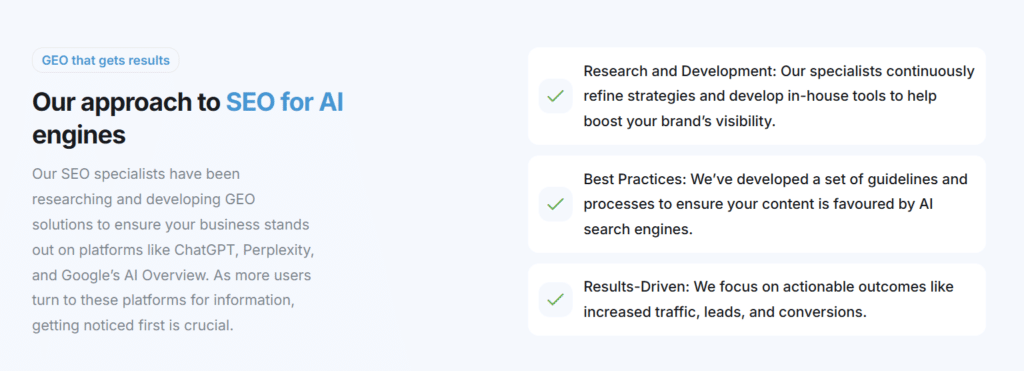
AI Search Optimisation Services
Closing Thoughts
For SEO professionals and marketing leaders, the playbook in 2026 is not about choosing between traditional SEO and these new channels. It is about doing both. The brands that invest in quality content, strong technical SEO foundations, and genuine AI brand visibility are the ones that will capture search traffic across every surface where their potential customers are looking.
Take your website to the next level with Dandy’s bespoke SEO services that really put results and clarity first.
👉 Get a free SEO audit today and get your site working smarter, not harder.
FAQs
Is organic search traffic still worth investing in?
Absolutely. Organic search traffic accounts for around 53% of all web traffic and delivers higher conversion rates than almost every other channel. Even with the rise of AI Overviews and zero-click searches, Google traffic overall grew in 2025 and organic leads still convert at 14.6% compared to 1.7% for outbound methods.
How much web traffic comes from mobile devices?
Mobile devices now generate between 62% and 64% of all global web traffic. Google completed its mobile-first indexing rollout in 2024, meaning the mobile version of your site is what Google uses to determine your rankings. If your site is slow or difficult to use on a phone, it will affect your visibility across the board.
Does Google traffic still matter with AI search growing?
Yes. Google remains the starting point for the vast majority of buying journeys, and 52% of search queries still do not trigger an AI Overview at all. The brands performing best in 2026 are treating AI visibility and traditional SEO as complementary rather than choosing one over the other.